Showing posts with label strategies. Show all posts

Thursday, April 18, 2019

More From the Trenches: Interleaving to Maintain Math Mastery


We are continuing our series of posts by Beth Guadagni, who shares the strategies she uses in her Colorado classroom. Today, she looks at how she uses interleaving to help students maintain math mastery.

Purpose:
To help students retain math procedures they’ve already learned.

Materials:

Math problems from previously studied units

Procedure:
I put together review sheets that students complete a few times a week. A simpler approach would be to flip backward in a textbook, choose a few pages at random, and do a problem from each section. Note that students should have a way to check their answers* if they’re going to tackle this independently.

Why This Works:

Like many students, my group generally does a good job of performing newly learned procedures once they’ve had some practice. Performing that procedure a few weeks or months down the road is a different story. To combat this, I use interleaving, one of Dr. Yellin’s most useful and widely applicable strategies.

One thing we know about memory is that we’re able to store a lot more things than we’re able to find easily, rather like a very large, disorganized closet. Brains are good at keeping thought processes efficient, and so information that we have to access often is stored in a place that makes it easier to find. Information we don’t need often, however, takes a lot longer to find, and sometimes we can’t find it at all. Here in Colorado, my students spend a lot of time enjoying the outdoors, so I use a trail analogy to explain this to them. A pathway that is traveled often is well worn, making easy to find and follow. You can hike faster along a trail that’s been traveled a lot, just like one’s brain can quickly find information that has to be accessed frequently. A less popular trail, though, like a seldom-referenced memory, is much more challenging. You might lose it altogether, and if you can follow it, your progress is going to be slowed by rocks and overgrown plants.


Back to math: Constantly circling back to concepts we covered earlier in the year causes my students continually access procedures they’ve stored in their long-term memories, communicating to their brains that this information is important and so the pathways to it need to be efficient. My students complete only a problem or two from each past unit of study at a time, and we spend only five to ten minutes reviewing every few days. This small investment pays off in a big way, though; when I graded their math finals at the end of the last semester, I was pleased to see that they recalled concepts from August just as well as the ones they’d learned in mid-December.


*See our previous post on Photomath, a free app that uses smartphone cameras to scan and solve math problems.
.
Photo by Matt Gross on Unsplash

Wednesday, February 22, 2017

How to Make Mistakes

There is no shortage of articles out there - in newspapers, magazines, parenting books, and empirical journals - that extol the virtues of helping children fail with pride. Most recently, Ed., the magazine of the Harvard Graduate School of Education, published a lengthy, informative piece about what teachers around the country are doing to introduce failure and mistakes into their classroom culture.

 
As a Learning Specialist at The Yellin Center, I find myself discussing the idea with parents on a regular basis: kids need to see the importance of not getting it right the first time. The concept matches up with Dr. Carol Dweck’s theory of mindset, which we introduced in a 2011 blog post. I even blogged about the importance of failure last fall. Despite the ongoing coverage on our blog and in the wider media universe, one big question remains. What about kids who have already learned to fear failure? How do we help rehabilitate their sense of try-try-again when they are already fearful of taking on big challenges? From a psychologist’s standpoint, I’d like to know the tools for reconditioning this aversion to failure out of our older students, and instilling in them a new appreciation for the learning curve. This common situation is often brought up by parents who are looking for tips and tricks to reteach their children (and themselves) how to make mistakes.

One very powerful example of the benefits of failure continues to pop up in articles and books – learning to walk. Babies spend quite a bit of time and energy pulling themselves up, only to fall back down. And once they’ve finally got standing under their belt, they are even more motivated to continue failing at walking. That is, until they succeed, as they all do, eventually. Babies don’t know that they’re supposed to be good at everything the first time; it seems like we’re hard-wired to push past our failures until we’ve accomplished our goal. If toddlers gave up trying to speak every time their words were misunderstood, we’d all be mute. Sharing this story with our middle- and high-schoolers can be one step in helping them rethink hardship.

One story, however, is not the cure-all. Many schools are already starting to incorporate a love of mistakes into their curriculum and climate, but it’s important for families to work together with schools so that students are surrounded by a supportive environment that values mastery over, for example, how something looks on a college application.

There are other strategies for parents to work on at home while classrooms are being slowly transformed into failure-friendly settings. First, be a positive role model. Consider the language you use about your own abilities, and introduce some new, visible challenges into your own life that your kids can watch you learn from. Even better is to involve them in the process. Maybe this means trying that really difficult recipe you’ve been putting off for years because you know it’s going to be a mess the first time around, or maybe you’ve always wanted to learn how to knit but you’ve made it known that you’re just not good with your hands. Now is your chance to model a new way of thinking about “ability” and growth. Give that recipe or that new hat a go, and laugh about it with your kids afterwards. And don’t forget to let them know how good you feel that you took a risk, and how excited you are to keep trying, because you know that deliberate practice is way more important than “talent.” Check out this episode of Freakonomics for more information about using deliberate practice to learn a new skill outside your comfort zone.

Once you’ve modeled the behavior, you can move on to offering the experience to your tweens and teens at home. It may be too much pressure for a middle- or high-schooler to give up the drive for perfection at school just yet, but any low-risk activity is a great starting point. This might be a really challenging video game, a new hobby, or a strenuous group activity like rock-climbing (there’s a reason we wear harnesses, right?). Paired with the right casual conversation about taking risks and messing up, any activity can jump start a child’s appreciation for falling off the proverbial horse. These activities, which don’t come with the same baggage as an upcoming math exam or the SAT, allow parents to embed little life lessons and healthier ways of thinking into conversation.

While you and your kids are working on making mistakes at home, it’s important to keep the conversation going with their teachers. Are students allowed to rewrite essays and correct their exams? Do teachers encourage students to take risks or, conversely, just to get high marks? Have teachers introduced the students to the language around mindset, grit, and failure? Odds are, your child’s school is already working to make failure an important and stress-free part of the learning process. Teachers and other school professionals could be a great resource for parents to learn more about how to support their children’s development, and open communication between parents and teachers is beneficial for everyone involved.

For more information about mindset, making mistakes, grit, and deliberate practice, check out the following books and resources:

  • A podcast interview with Duckworth, the author of Grit
  • "Mistakes Were Made" in the Harvard Ed. magazine, referenced at the beginning of this post.

Friday, August 12, 2016

Building Success through our Approach to Failure

With this post, we are pleased to introduce the newest member of our blogging team, Yellin Center Learning Specialist Jacqui Kluger, M.S., Ed. Jacqui has spent the past five years as an instructor for graduate and undergraduate psychology and education students in the City University of New York system, as well as working at several public and private schools. Welcome aboard, Jacqui!


We already know that when we view our abilities as plastic, or malleable and always growing, we (and our kids) approach roadblocks and challenges in a more constructive way. The question, then, is how to pass a growth mindset along so students have the tools to persevere in the face of hardships at school. A recent study by Kyla Haimovitz and Carol Dweck began to answer this question. They found that the way a parent approaches experiences of failure predicts how students perceived “being smart.” In other words, parents’ “failure mindsets” were related to whether children viewed their own abilities as fixed or plastic. 

Haimovitz and Dweck point out that a parent’s approach to failure is visible to students through parent behavior towards student failure. How a parent reacts when a student comes home with not-so-good news has a big impact on how that student feels about his or her abilities and intelligence. Some adults have a “failure-is-debilitating” view, which is the belief that failure is a reflection of our ability and is a setback. Others have a view of failure as an opportunity and a time of growth that leads to increased ability and mastery down the road. When parents focus on students’ current performance or fixed ability in the face of failure, kids do the same. When we focus on the opportunity at hand – the learning and mastery that comes after the initial failure – then kids begin to develop the growth mindset we know is so important for academic and socio-emotional success.

All students experience failure at some point in their educational careers, whether it’s a low exam grade or not getting the lead role in the winter play. According to the study, we should react to students’ failure with support for their learning and mastery. This may include providing strategies for different study methods, seeking outside support, promoting interest and enjoyment of material beyond quantifiable performance, or simply highlighting the idea that learning is an ongoing process. Let’s not forget that the journey is more important than the destination.


Photo: Erin Resso for flickr cc

Wednesday, April 27, 2016

Supporting Anxious Children

While collaborating with fellow teachers in different parts of the country, your blogger has noticed a common theme: anxiety in students is becoming a much more salient issue in today’s classrooms. Data supports the notation that anxious tendencies in children is on the rise; a study conducted by the National Institute of Mental Health found that 25.1 percent of kids 13-18 in the United States have been diagnosed with anxiety disorders. 

Many colleagues have shared that they feel ill equipped and under prepared to mitigate these types of social-emotional and behavioral challenges. But behavior and self-regulation aren’t the only concerns teachers or caregivers are faced with when supporting children with mental health issues. Students who are dealing with psycho-social stressors often struggle to focus on their learning and their academic performance often wanes as a result. For example, a study published in the Journal of Abnormal Child Psychology surveyed a group of 1,197 students without a diagnosed reading or math disability. The students who were diagnosed with an anxiety disorder were more likely to be in lower achieving reading and math groups.

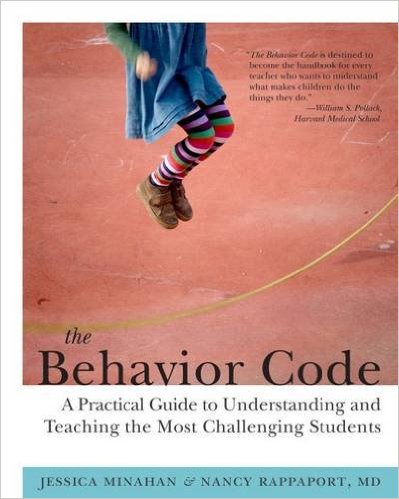
We have written before about self-regulation strategies and teaching children mindfulness; some of these ideas and tools may be effective interventions for helping students cope with anxiety and behavioral difficulties. However, another excellent resource is an informative book written by Dr. Nancy Rappaport and Jessica Minahan titled The Behavior Code: A Practical Guide to Understanding and Teaching the Most Challenging Students. The Behavior Code provides strategies to determine causes and patterns of behavior in order to effectively de-escalate challenging situations. The book is also a treasure trove of worksheets and practical resources.


In their book, the authors emphasize that misbehavior is a symptom of an underlying cause and is a form of communication that serves a function and has a pattern to it. They explain that a displayed maladaptive behavior is often the symptom of underdeveloped skills, such as weak executive functioning, poor self-regulation, or immature social skills. The behavior is often the child’s attempt at solving a problem the best way they know how. Children will continue to engage in the problematic behavior due to the function it serves in getting them a desired result. For example, whining may get the teacher’s attention. Often, when teachers systematically evaluate behavior they will discover a pattern to what triggers or causes the behavior and what function it is serving. Knowing the cause, function, and pattern to challenging behavior is the first step towards helping build effective, personalized, interventions in order to support the child

The authors also provide some tangible tips for working with anxious students:
  • It is common for teachers or caregivers to publicly praise positive behavior. However, children with anxiety don’t always want any extra attention from peers, which can make this strategy ineffective. Private or non-verbal praise is often better for students with anxious tendencies.
  • Students with anxiety often enter into negative thinking cycles. Vague or non-specific praise is easy for them to dismiss. The authors suggest using fact-based praise with specific examples of how the student has done. 
  • There are new biofeedback tools that can turn calming down into a game for students. One such tool is EmWave, which gives students a black and white picture that will slowly fill with color as the device monitors the child’s heart rate and the student begins to calm.

Friday, June 12, 2015

Recommended Reads for High-Level Students

Lots of people mistakenly think that success in difficult high school, college, or graduate-level courses is directly related to a student’s intelligence. Others believe it’s all about motivation. Smart, driven young people, the myth goes, are bound to do well, and if a student struggles it must be because she isn’t bright enough or lacks the will power to put in the time and effort.

These misconceptions can be very damaging to students. At The Yellin Center, we frequently work with students who blow us away with their intelligence, yet still struggle in school. More often than not, these sharp young people simply need to learn strategies to help them manage difficult coursework. Many times the strategies are not even especially complicated; they’re simply ways to conceptualize important relationships in curriculum, track their schedule, or organize ideas that a student hasn’t tried before.

Ambitious students who want ideas for new strategies that will help them learn more efficiently and produce high-quality work reliably will find two books tremendously useful: On Course by Skip Downing and Becoming a Master Student by Dave Ellis. Although neither book is inexpensive, both are filled with the kinds of tricks that the curve-wrecking students are already using, often without even realizing it.

On Course starts with a self-assessment tool that students can use to identify behaviors and beliefs that they wish to change. Part philosophy treatise, part bag of tricks, the book helps students understand what causes tendencies they don’t like and guides them through processes for adjusting their habits. On Course is also full of practical tips for taking good notes, improving reading comprehension, studying effectively, and more.

Students should try to get a new, hard copy of Becoming a Master Student, if possible, because many exercises in the book will require them to write on its pages. Like On Course, Becoming a Master Student helps young people to make discoveries about themselves and their habits, since understanding a problem is a critical first step to fixing it. In addition to lots of effective, specific strategies for helping students succeed academically, the newest edition provides information about cutting-edge technologies that make learning, organization, and time management feel easier.

Wednesday, April 1, 2015

Frontloading: Getting Ready to Read

Whether you are planning a trip, getting ready to prepare a complicated recipe, or starting on a project for work, preparation is an important first step and is crucial to success. It's the same thing for reading new material for school. Students who take the time to prepare before beginning to read -- a process called frontloading -- will get more from their reading and retain the information better. Frontloading can include scanning the material for main ideas, important details, themes, structure, and tone; researching new vocabulary; accessing or building background knowledge connected to the topic at hand; and creating or locating related visuals.


Here are some of the ways we suggest students engage in frontloading:

  • Think about the topic before starting to read, taking time to consider any prior knowledge that you may have about the topic. 
  • Do an internet search on the subject prior to reading grade-level material.  For fictional texts, you can read condensed texts like CliffsNotes or SparkNotes. This will provide you with prior knowledge and give you more of a sense of mastery when you try to read the more challenging text. You should also scan the text for any new and challenging vocabulary.
  • Before reading the assigned text, review any questions at the end of the chapter or which the teacher may have given out
  • Learn how to use information in textbooks, since they already have built-in cues to help determine important points.  For example,  make note of all titles and headings; scan for important information in pictures and captions; and look for key terms, concepts, or people that may be italicized, underlined, or written in bold type.
  • Consider developing a written and/or visual time line for historical and narrative events.  This activity can improve your appreciation of time sequences and causal reasoning. 
  • Consider using the website WordSift. This site will help you preview challenging text by identifying the key vocabulary, locating relevant images, and using the example source sentence feature to “skim” the text.   
Not all of these frontloading strategies will be helpful for every student, but trying them out and figuring what works for you can be a good first step to mastering challenging reading material.


Friday, February 27, 2015

Tips for a Manageable Email Inbox

Peeking into a student's backpack or dorm room used to be a good indicator of his organizational skills. But these days a student's email inbox may be more revealing than the way he manages his paper load. Information and documents are increasingly distributed to students via email instead of on paper, and many students aren't able to stay on top of their electronic clutter. We considered tips from organizational coach K.J. McCorry, founder of an environmentally-focused organizational consulting business called Eco-Officiency, and did some of our own brainstorming as well, to come up with this advice for students (and, just maybe, parents, too):
  • Reduce: An easy way to combat inbox overflow is to get fewer emails, which can be accomplished in a few ways. First, set up a "dummy" email account and use it for all online purchases and other occasions when you must share your email address with an unimportant third party. This way, if your email address is shared, only your dummy account's inbox will fill up. Second, unsubscribe from solicitations. They may be hard to see, but "unsubscribe" links should be at the bottom of all marketing emails. Don't believe the myth that opening sales emails will cause you to receive more of them; get yourself off all of those lists. 
  • Set-up for success: Nearly all email platforms allow users to create folders. We suggest that students create one folder for each class (chemistry, English, etc.), one for their personal communications, and one for each extra-curricular activity (band, soccer, etc.) in which they are involved. It may sound unattainable, but hear us out: the goal should be to have zero emails in one's inbox because they've all be placed in the right folders.
  • Order of Operations: McCorry recommends checking email about five times a day; a lot more or less than that negatively impacts productivity. Each time a student signs on, McCorry suggests that they first delete all spam and irrelevant messages. Second, they should answer all emails that require only a quick response. Follow the three R's here: Read, Respond, Remove. By skimming quickie emails, jotting a short response ("We're meeting on the second floor of the library. Don't forget to bring notecards!") and dragging these messages to the right folder, inboxes will seem less intimidating in no time.
  • Just Do It (Now): McCorry's steps should leave only a few emails that require careful reading and/or a thoughtful response in a student's inbox. This is great news because it means the important stuff won't get lost in a queue of other messages. McCorry suggests taking care of those time-consuming responses ASAP to avoid creating a backlog in one's inbox. Remember, waiting to respond means having to reread the email later before typing a reply, which is a big waste of time. Instead, students should bite the bullet and respond immediately while the email's contents are still fresh.
There's no single way to manage email, but we hope these tips will help. They certainly work for us!

photo credit: EUNOIA via FlickrCC

Monday, July 29, 2013

Easing Into a School Sleep Schedule

July is winding down and August is coming up fast -- and for many families that means the start of the school year. Even here in New York City, where school usually starts later than most places, teachers report on September 3rd, although religious holidays push back the start for students until September 9.

Adam Inglis
One important way that parents can help students of all ages get ready for the upcoming school year is to think about sleep We've written before about the importance of sleep and how sufficient, high-quality sleep is crucial for optimal academic performance. When we work with students and parents we inquire about sleep and look at how inadequate sleep, or sleep disruptions, may impact student performance.

During the summer, it's easy for families to put aside strict bedtime rituals and for children to go to bed later than usual, or to sleep well into the morning. Teens who find summer a great time to socialize without the demands of homework may be up later than they would during the school year. And parents, who have enforced bedtimes during the school year, may themselves want a break from arguing about when it is time to go to bed.

Unfortunately, moving from the pace of summer to the more demanding days of school, and the need for a reasonable amount of sleep before leaving home at an early hour, can't happen the night before school starts. Families need to start at least a couple of weeks in advance -- more if possible -- to ease into the schedule they will follow in the fall. It's also important to think about whether your child's regular school year sleep patterns provide sufficient good quality sleep to help make their upcoming year a success.

Friday, June 7, 2013

Test-Prep Tips: Studying for Finals

albertogp123
The school year is winding down, which means shows and concerts, yearbooks, and summer plans. But first, students in middle school and high school need to get through (sigh) final exams. For most students, the prospect of preparing for cumulative exams is a daunting one. Here are some tried-and-true ideas for students to help make their test preparation a success:

  • Learn everything you can about the test. If your teacher has given you a study guide, great! If not, find out exactly which chapters or concepts you’ll need to know for the exam. If you don’t already know, ask how much time you’ll be given and whether your teacher will be allowing students extra time to finish if they choose to stay longer. It can also be helpful to learn the format of the test; ask your teacher if she will share the test directions with you before test day. Students who are slower workers can study the directions before test day so they don’t need to take time to read them while testing. 
  • Devise a study schedule. Sit down with a blank calendar and your study guide and start planning. Figure out exactly which days will be devoted to covering which classes and which specific topics/chapters. Don’t be vague or general - really spell it out. Be sure to plan some “padding” so that your schedule isn't completely thrown off if you need an extra day here or there to cover a topic in more depth. Planning your schedule should be the first step you take outside of class. Do this before you start studying.
  • Give yourself study breaks as you feel your mind starting to get tired. Taking breaks is not a waste of time, but studying when you’re mentally exhausted is. Your brain can’t absorb material when it’s worn out. Give yourself some time to recharge, preferably by moving around – just be sure your break doesn't last more than 10-20 minutes. When you return to hit the books, cover your notes and summarize for yourself everything you learned before your break. Then check your summary against your notes to make sure you didn't forget anything. This will help you get back on track, and will give your memory an extra workout. 
  • Test yourself. The biggest mistake we see students make is to read over their notes and believe this prepares them. It doesn't. To be truly ready for a test, you need to practice retrieving the information from your long-term memory. Instead of reading over your notes, cover them and ask yourself questions, answer the questions in your head or on paper, then check your answers against your notes. Flashcards are another great way to test yourself. You could also plan a study session with a friend and take turns quizzing each other. One of our favorite study strategies is to make your own practice test! Make up questions like the ones you predict will be on the test, copying the test format, if you can. Do this about a week before the test. Wait a day or two and take your test without looking at your notes. When you check your answers, you’ll be able to tell what you've learned and what you need to review. You may even want to trade your practice test with a friend for a little extra practice.

With these tips in mind, students should be ready to put in the kind of studying that will have them prepared for even the most comprehensive finals! Stay tuned for a future post about test-day tips and test-taking strategies.

Friday, April 5, 2013

Thinking about ADHD

An article in last week’s New York Times, "A.D.H.D.Seen in 11% of U.S. Children as Diagnoses Rise," raises some important issues. The article concerns data from a CDC study which interviewed more than 76,000 parents between February 2011 and June 2012 as part of a wide-ranging look at children’s health issues. The CDC has not yet published its findings, but the Times used the raw data as the basis of the article.

According to the Times, diagnoses of ADHD in the U.S. have risen some 41% in the past decade, and 11% of school-age children have received a diagnosis of ADHD. It also reported that about two-thirds of those diagnosed received a prescription for stimulant medication. 

The article continued by noting that the criteria for ADHD -- a checklist of symptoms occurring across situations (for instance both at home and at school) over a period of time -- was due to be expanded in the new Fifth Edition of the DSM, due out this May. This is expected to add to the numbers of teens and adults who are diagnosed with ADHD. 

So, what does this mean for you, for your child, and for clinicians? 

First, parents need to understand that just because a child has difficulties with attention does not mean that he has ADHD. There can be many reasons for attention issues and children can fidget for many reasons. Thoughtful clinicians need to apply the time tested medical approach of “differential diagnosis” when they look at the symptoms commonly associated with ADHD. "Why," they should always ask, "are these behaviors present?" Does this student have a language difficulty, so that she has trouble understanding what is going on in class? It can be hard to pay attention when you can’t follow the classroom discourse. Does he have a problem with memory, so that he jumps and shouts out so that the teacher will call on him before he forgets what he wants to say? Or, perhaps, does she have a true deficit of attention which may or may not be accompanied by hyperactivity?

Even when children have ADHD, we must be thoughtful about what the best strategies may be to deal with this problem. There are many interventions that can and should be tried before using medication. In fact, medications are NEVER sufficient alone. They must always be prescribed in the context of a comprehensive educational plan that includes strategies students, educators, and parents can implement on a daily basis.

Building self-awareness must also be part of the treatment. A child can have ADHD without being ADHD. They must learn about their strengths, and understand that attention weakness exists within the context of their strengths, and perhaps other weaknesses. Attention is a multi-faceted function that appears to involve at least three different parts of a child’s brain. A child needs to know what parts of attention are the sources of their difficulty, and perhaps what parts of attention are working well for them. Attention problems rarely exist in isolation. We owe it to our children to ask, “What else might be contributing to their difficulty?” 

We understand that medication can be enormously helpful for many children for whom the benefits greatly exceed the risks. However, as is the case with every medical treatment, the risks and benefits must be considered on a case-by-case basis. I believe our role as clinicians is to provide parents with the best information that we can and with our best judgment. However, I worry when I hear that parents had their child “tested for ADHD.” I am not saying that the possibility of an ADHD diagnosis shouldn't be considered. What I am saying is that it must be considered in the context of thoughtful consideration of all of the possible causes of a child’s symptoms. And once a diagnosis has been made, medication must be examined in the context of all of the potential interventions.


Illustration: Life Mental Health

Friday, February 8, 2013

Coping with Test Anxiety: Worriers Versus Warriors

Most of us have been there: butterflies in the stomach, clammy hands that tremble, difficulty breathing. Test anxiety is all too familiar to most of us. A recent article in The New York Times by Po Bronson and Ashley Merryman (also authors of Top Dog: The Science of Winning and Losing) explores why some kids (Warriors) seem to approach exams with cavalier nonchalance while others (Worriers) are seized with paralyzing stress. Of course, human behavior is influenced by a multitude of factors, but there’s also a compelling genetic explanation for this phenomenon. When a person experiences stress, the prefrontal cortex of his/her brain is flooded with the chemical dopamine. Because our brains work best when dopamine levels are controlled, the gene responsible for clearing that dopamine, a gene called the COMT gene, sets to work to restore balance. COMT, however, comes in two varieties. The first clears the dopamine slowly. The second clears it rapidly. Those who have the rapid removal version of COMT, Warriors, tend to perform better under stress. Worriers on the other hand, whose brains seem to become saturated with dopamine, often experience a drop in performance.

Here’s the part that makes this seem particularly unfair to Worriers: A slow-acting COMT gene is typically associated with higher cognitive and executive function skills. So students with higher cognitive abilities who sit down to a test are at a larger disadvantage than their less academically able classmates. The Times articles notes that a study in Taiwan demonstrated that students with higher IQs coupled with the slow-removal gene under-performed their fast-acting COMT-endowed counterparts on a high-stakes national exam.

This seems like bad news for Worriers, but, happily, there is hope. Studies of stress indicate that, like much else in life, the spin we put on a situation has an enormous impact on the way we deal with it. According to the authors, both amateur and professional athletes have been found to experience the same levels of stress before competition. The difference? The amateurs view stress as a derailing force while the professionals view it as an energizing one. The article notes that a study at Harvard put this principle to the test in an academic setting. Before taking a practice test, some students were given a statement explaining to them that stress actually improved test performance. Not only did that group out-perform the control group on the practice test, but they attained higher scores again when they took the actual GRE weeks later.

Part of managing test anxiety, then, is a matter of philosophy. The other comes with good, old-fashioned practice. The authors advocate “training, preparation, and repetition” as the best way to prepare Worriers for a stressful event. Here are some of our ideas for combating test anxiety, whether you’re coaching a student in your life, or yourself:

  • Allow the student to verbalize what she is feeling and help her by giving her the right language if she struggles. If talking it out is too hard, ask her to write about her thoughts. 

  • Help the student to understand that stress is not only normal but potentially beneficial. Share with him the story about stress experienced by amateur and professional athletes. Talk about viewing stress as a positive phenomenon. 

  • Physical relaxation can sometimes trigger mental clarity. Help students learn self-coaching language, or teach them to tense, then relax, various muscle groups. Some students may feel better if they have the chance to engage in physical activity before a test, like doing some yoga poses or going for a jog. 

  • Familiarity with test-day factors can be enormously helpful in combating stress. Help your student take practice tests, ideally under the same conditions in which she will face the real thing (i.e. setting, time constraints, etc.) If all that isn’t possible, visit the test site, review the testing procedures with your student using the verbatim instructions if you can find them, etc. 

  • Scholastic competitions (the math team, spelling bees, etc.) can serve as what the authors call “inoculation” for Worriers. Encourage your student to participate in such activities.


Monday, February 4, 2013

Practicing with Clocks

Telling time with analog clocks seems to be especially challenging for children. Is it the proliferation of digital clocks? Whatever the reason, here at The Yellin Center we often work with children who are great at math except for those pesky clocks. How to help kids practice? Giving a child an attractive analog watch that will motivate him or her to use it often can be very effective. Here are two more fun, easy ideas to get youngsters excited about and comfortable with telling time from analog clocks:

Paper Plate Clocks


Supplies: two paper plates, something to write with, glue, a brad, colored paper, a hole punch

Make a clock with a “cheat sheet” underneath! Begin by writing the numbers 1-12 around the perimeter of a paper plate so that it resembles a clock face. Make cuts between each of the numbers so that they resemble tabs which can be folded toward the center of the clock. Next, write the numbers 00, 05, 10, etc. around the perimeter of a second plate so that they line up with the numbers on the “clock.” Now punch a hole in the center of each plate. Spread a small amount of glue on the second plate (the one with 00, 05, etc. on it) around the hole you punched and lay the “clock” plate on top. Use a brad to join the plates and to attach two paper clock hands. The finished product should look like a regular clock with movable hands, but this one allows students to fold down the numbers to help them practice telling time to the minute. For example, if the minute hand is pointing at the 7, a child can fold the 7 toward the middle of the clock to reveal the hidden 35 underneath. Practice moving the hands to various positions and asking children what time it is now.

Daily Routine Clocks


Supplies: paper, scissors, something to write with

For kids who have predictable schedules, make and label a different clock for each event. For example, if your child has soccer practice each day at 4:30, construct a paper clock showing 4:30 and label it “Soccer Practice.” If your family eats dinner each night at 7:00, make a “Dinner” clock as well. Tack your paper clocks on the wall around a working analog clock, and when children ask what time an event will take place, ask them to find the right paper clock and compare it with the real clock. For more advanced time tellers, ask them how long it will be until an event happens.

Thanks to Clutter Free Classroom and Teacher Web for great inspiration!

Friday, January 25, 2013

Fun with Math Facts – Really!

It is widely accepted that drilling with flashcards is an effective way to get children to memorize math facts. It is also widely accepted that flashcards are hardly a fun way to spend time. Try motivating kids to do math by making a few minor adjustments to games that are already family favorites, however, and kids won’t be able to get enough (and may even want to keep playing on their own)!


Math War

Works for: addition, multiplication


In this version of war, each player lays down two cards at once instead of one and, depending on the skill being targeted, has to either add or multiply the numbers on their cards together. The player with the higher total gets to keep all four cards. Face cards and aces can be removed from the deck, or you can add an extra twist by assigning them other values (they can be 1’s, higher numbers, wild cards, or negative signs for older students). Note: If there are more than two players, shuffling two decks together might be best to avoid running out of cards too quickly.


Math Checkers

Works for: addition, subtraction, multiplication


This game requires a bit more preparation. Cut post-it notes so that they are small enough to stick onto the black squares of a checkerboard, and write random numbers on each. Then use tape to affix more numbers on each of the checker pieces. If you are targeting multiplication or addition, the numbers can be random, but be sure that the numbers on the pieces are higher than the numbers on the board if you are targeting subtraction; the exception is if you want the student to practice negative numbers as well. Then play checkers as usual. Each time a player moves to a new square s/he must combine the number on the piece with the number on the board. This game takes jumping to a whole new level, as students will have to perform several operations for each square they hit!


More-Math Monopoly

Works for: addition, multiplication


Monopoly already provides lots of practice with addition and counting money. You can easily add another layer of math practice by requiring each player to add or multiply the numbers on the dice together each time s/he rolls. The whole family can play this game if younger players need only add while older players are required to multiply. Note: This concept can be adapted to any game that is played with two dice.


Blackjack

Works for: addition


It’s no secret that addition skills are needed for this game, but it’s not one parents typically think about playing with their children on a wholesome family game night. Blackjack is fantastic for improving math fact knowledge, however, and it teaches children about probability, too. Remove the gambling aspect by playing a best-of-ten series and keeping score, or else bet with pennies, M&M’s or poker chips that can be cashed in for additional minutes of video game time, choice of dessert at dinner, or some other treat.

Wednesday, January 23, 2013

Foldable Flashcard Alternative

Out of index cards? Worried that your child will lose his flashcards after he takes the time to make a stack? To study for tests that require paired associate memory (the part of memory that links two pieces of information together, such as a Spanish vocabulary word to the English translation), try this fun foldable flashcard alternative:


1) Fold a piece of notebook paper in half vertically.

2) Unfold the paper and cut along every third printed line until you get to the fold. You should have a series of tabs on one side of the fold and solid paper on the other.

3) Fold the tabs back down. Write one of the element symbols/vocabulary words/math facts to be memorized on each one.

4) Lift the tab and write the corresponding element/definition/answer so that it is positioned underneath the tab.

5) Quiz your child, or show them how to do it themselves.

6) Pass the test with flying colors and celebrate!


For more resources for parents, teachers, and students, visit www.yellincenter.com/resources.


Photo: Jeremy Koren 

Monday, January 14, 2013

Super Single-Sentence Summaries

Summarizing is a great technique for boosting reading comprehension. Students who learn to produce great summaries are practicing saliency determination (figuring out what is most important as they read) as they work to separate the main ideas from the details. They’re also putting their memories through valuable exercise regimens by practicing information retrieval. But sometimes creating the same old summaries again and again can get a bit stale.


One way to spice up the summarization routine, as well as to help kids put new vocabulary words to work, is to ask them to provide short summaries around specific words selected from the text. Imagine a child reads an article about a NASA rover sent to investigate the surface of Mars. Parents and teachers can pick several words from a reading and prompt students to create single-sentence summaries. For example:

  • Think of a sentence that uses the word “crater” and describes something important you learned from this article. 
  • Think of a sentence using the word “geology” that tells something important explained in this article. 

Students learning in groups might all take turns contributing their own sentences in response to the instructor’s query.

Single-sentence summaries would be great tools for exploring themes in literature, too. Rather than asking for a basic summary of a book or a chapter, a teacher could select several individual words that express different themes explored in the reading (or, for older students, ask them to contribute) and ask students to create sentences based on those words. For example:

  • Can you think of a sentence using the word “imagination” that describes Harry? 

These brief summaries might be enough to get kids thinking, or adults may want to use this activity to prepare students for writing/telling longer, more traditional summaries about reading. Either way, they’re a great way to encourage students to use new words and for teachers to lead students to consider certain angles of a text. And they’re certainly more interesting and fun than having to do the same old summary exercise again.


This article is based on ideas found in “Simple Summaries, Fabulous Finds” in The Reading Teacher, 65(8).


Photo: CC by garysan97

Monday, July 9, 2012

Flipping and Frontloading to Enhance Learning

A recent article by Jo Napolitano in Long Island's Newsday looked at the increasing popularity of "flipping a classroom" where teachers provide their lessons in video format prior to the class and students are responsible for accessing this new material independently, before the class period. In this educational model class time is then reserved for reinforcing the material presented in the video and expanding the lesson to encompass additional, generally enriched material. Students are expected to demonstrate that they have actually followed the video at home by taking notes and responding to questions set out in the materials. 

The benefits of this model include additional time for individual and small group instruction, the opportunity for students to pause the video, or to rewind and listen to some or all of a lesson again. This differs from the pace of classroom lecture, where once something has been stated, it is generally not repeated; a student who loses focus for a moment may miss crucial material. Some science teachers note that this model allows them more time for demonstrations and experiments in class. Detractors complain that students who do not have computers or smartphones readily available to view the lessons are at a significant disadvantage, even if schools make such devices available in libraries or elsewhere in the school building. 

What we find of particular interest in this educational model is how closely it resembles a low tech approach that we frequently recommend to students -- frontloading. Frontloading is the process of preparing to learn by becoming familiar with the concepts and vocabulary the student will encounter in a lesson. Some examples of frontloading include using available texts for clues about what is important by looking at questions at the end of chapters, bold-face headings, and section titles. Students can research vocabulary, read simple books on the subject, and search the internet for related materials. Teachers can faciliate frontloading by providing students with vocabulary specific to the upcoming lesson or by introducing a subject with models, artifacts, or even outside speakers on an important topic. 

What flipping and frontloading have in common is the recognition that by preparing students to learn a lesson they can better absorb the material and get the most out of their classroom experience.

Friday, June 8, 2012

Test Taking as a Study Tool

No one likes taking tests. But research has continually demonstrated that it is test taking, not reading or trying to memorize, that produces the best outcomes for students. In a keynote presentation to The Association for Psychological Science convention in May, Dr. Henry L. Roediger, III of Washington University's Memory Lab addressed this issue in a talk entitled "The Surprising Power of Retrieval Practice in Improving Retention: From the Lab to the Classroom."

As reported in Education Week, Professor's Roediger's research team has found that testing itself, ideally from five to seven "retrieval sessions," seems to enable students to really understand a particular concept. The process of taking a quiz or testing yourself on material actually transforms your understanding of the material, according to Professor Roediger, and that means that you will do better on future tests than if you simply memorized the material for a single upcoming test. 

Other researchers whose work was presented at the conference had similar findings.

Dr. Jeffrey D. Karpicke of Perdue University presented the results of a study of college students asked to use various methods to learn science material. Those who quizzed themselves did roughly ten percent better on all kinds of questions than those who read the material repeatedly and even those who created concept maps of the material. 

Here at The Yellin Center we often recommend that students create tests -- by themselves or in a study group -- as an important part of their studying process.


Wednesday, June 6, 2012

An Award-Winning Memory

Creative Commons Attribution-Share Alike 3.0 Unported license
Joshua Foer
In 2005 journalist Joshua Foer covered the U.S.A. Memory Championships for a story. He was fascinated by the event, which challenges competitors to push their memories to the limit by recalling decks of cards in sequence, a previously unpublished poem, long lists of numbers, or fictitious first and last names associated with photographs of various people. The more Foer saw, the more he was fascinated by the competitors' apparently limitless capacities for holding information. He began to study memory and to do his own experiments. A year later, he returned to the Championships, this time as a competitor. Not only did he win, but he set a new record in the "speed cards" event by memorizing an entire deck of cards in only one minute and forty seconds.

Foer describes how he accomplished this feat in an intriguing TED talk. TED is a nonprofit whose mission is to bring together individuals from the worlds of technology, entertainment, and design to share what they know at conferences and via "talks" on their website, among other means. Foer swears that he does not have a particularly great memory. Anyone, he says in his talk, can accomplish this sort of thing.  

Foer was able to learn all the cards because he had dedicated time and energy to assigning each card a celebrity match and memorizing them. For example, the six of hearts might be Britney Spears, the jack of diamonds might be Mickey Rooney, etc. He made sure to select celebrities that were meaningful to him and whom he could clearly visualize; for example, famous as author Mary Shelley may be, it's hard to picture her. Then he practiced by going through a decks of cards, imagining very vivid scenarios in which he walked through his house and encountered each of the characters in the order that their cards were drawn from the deck. When the cards were taken away he simply replayed the scenario in his head and was able to "see" each of the celebrities and associate each with their card.

While this particular situation is not one we encounter often at The Yellin Center, Foer's message about memory echoes advice we often give students: To remember something, one has to figure out a way to convert the information into another format that will make it meaningful. For example, to remember information about the Battle of Gettysburg for a test, a student could draw the battle, representing the different battalions and their actions throughout the conflict. The student could act it out with friends or with Lego people. The student could picture the battle vivdly in his/her head, or find a documentary or a narrative account of the battle. It may also be valuable to compare and contrast the Battle of Gettysburg with something the student knows well, ranging from another battle to a football game.

Memory strategies are generally not one-size-fits-all, meaning that learners will have to experiment to figure out which kinds of transformations will make the information meaningful, and therefore memorable, to them. But as Foer, the journalist turned memory champion, demonstrates, seemingly superhuman feats of memory are not as superhuman as they seem.


Monday, June 4, 2012

Beating Writer’s Block

Many kids struggle with writing, but for some, the difficulties have nothing to do with remembering when to use a semicolon. Writer’s block can be infinitely frustrating to students, and it can happen for a number of different reasons. "io9," a website aimed at fans of science fiction, in a nod to those of its readers who are also writers, offers some helpful tips that just may help the young writers in your life release the floodgates of words and ideas. Try sharing some of these ideas with stuck students:

Problem: You can’t come up with an idea.

Solutions: Do writing exercises to get your fingers moving and warm up your mind. Write a profile of an intriguing character you've come up with, even if you can’t figure out how to work him/her into a story. Do a free-write about your assigned topic – jot down anything and everything that pops into your head, and don’t worry about whether it makes sense. Rewrite the ending of a classic story/book/movie. Describe a photograph. Borrow someone else’s characters and throw them all into an elevator together to see what happens. Don’t worry about where your effort ends up taking you, just get those words flowing.

Problem: The idea of being critiqued later paralyzes you. 

Solution: Remind yourself that your rough draft is meant to be revised and get through it. You can change anything in a revision after you’re done writing, but having nothing is worse than having something mediocre that can be improved.

Problem: You can’t stop obsessing about that perfect, elusive word that’s hovering on the tip of your tongue.

Solutions: Stick any similar word in the sentence and move on. Highlight, underline, or star the word that needs to be changed so you don’t have to remember it and can direct your attention to more important things – like continuing to write. Stopping in the middle of a piece of writing can make it nearly impossible to pick up your momentum again. Paying close attention to writing and being precise with your words is great, but don’t allow it to stem the flow of your productivity. 

Photo credit: Rennett Stowe/Flickr Creative Commons

Friday, May 11, 2012

Vocabulary Knowledge Scale

Memory is a strange animal indeed. Recent research suggests that people have difficulty differentiating between what they know and what is familiar to them unless they are specifically prompted to do so. Dr. Yellin likes to share a story about a conference about memory he attended in which the lecturer asked the attendees how many of them knew how a toilet worked. Most of the hands in the room went up. The lecturer then asked how many of them could explain it step by step. Nearly every hand went down. This is the difference between familiarity and mastery: Just because our memories have encountered a concept before does not mean that we understand it thoroughly.

The first step in transitioning from a recognizer to a master of a concept is to determine where the gaps are, and sometimes that realization takes some outside prompting. This issue is particularly prevalent in the issue of vocabulary. Many students will say that they know a word’s meaning only to be unable to define it when asked. Chances are they’re not being cheeky; their brains are just confusing familiarity with mastery. To help students combat this, a vocabulary scale can be a great tool. 

The scale is made up of four levels:

Level 1 – I can define that word and use it in a sentence.

Level 2 – I’ve heard that word before and know the gist of it. I may be able to give you some examples or use it in a sentence, but I can’t come up with a solid definition.

Level 3 – I’ve heard that word before, but I have no idea what it means.

Level 4 – Huh? I’ve never heard or seen that word.

If an adult working or talking with a student suspects that a student does not know a word, s/he should ask the student to determine which level the word is for them using the scale. Sometimes, simply discussing a Level 2 word is enough to help students construct a definition for it. Words from Level 3 and 4 should be taken in context, and preferably in the context of other sentences as well, deconstructed, and looked up.

The vocabulary scale is not intended to instruct students in vocabulary, per se. It can, however, make students more self-aware of their levels of word knowledge, making it even more powerful than any curriculum.