Showing posts with label self-control. Show all posts

Wednesday, April 27, 2016

Supporting Anxious Children

While collaborating with fellow teachers in different parts of the country, your blogger has noticed a common theme: anxiety in students is becoming a much more salient issue in today’s classrooms. Data supports the notation that anxious tendencies in children is on the rise; a study conducted by the National Institute of Mental Health found that 25.1 percent of kids 13-18 in the United States have been diagnosed with anxiety disorders. 

Many colleagues have shared that they feel ill equipped and under prepared to mitigate these types of social-emotional and behavioral challenges. But behavior and self-regulation aren’t the only concerns teachers or caregivers are faced with when supporting children with mental health issues. Students who are dealing with psycho-social stressors often struggle to focus on their learning and their academic performance often wanes as a result. For example, a study published in the Journal of Abnormal Child Psychology surveyed a group of 1,197 students without a diagnosed reading or math disability. The students who were diagnosed with an anxiety disorder were more likely to be in lower achieving reading and math groups.

We have written before about self-regulation strategies and teaching children mindfulness; some of these ideas and tools may be effective interventions for helping students cope with anxiety and behavioral difficulties. However, another excellent resource is an informative book written by Dr. Nancy Rappaport and Jessica Minahan titled The Behavior Code: A Practical Guide to Understanding and Teaching the Most Challenging Students. The Behavior Code provides strategies to determine causes and patterns of behavior in order to effectively de-escalate challenging situations. The book is also a treasure trove of worksheets and practical resources.
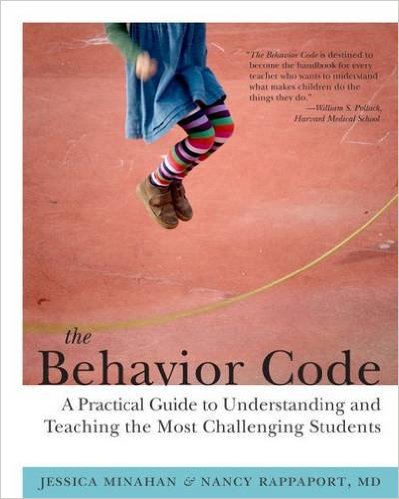

In their book, the authors emphasize that misbehavior is a symptom of an underlying cause and is a form of communication that serves a function and has a pattern to it. They explain that a displayed maladaptive behavior is often the symptom of underdeveloped skills, such as weak executive functioning, poor self-regulation, or immature social skills. The behavior is often the child’s attempt at solving a problem the best way they know how. Children will continue to engage in the problematic behavior due to the function it serves in getting them a desired result. For example, whining may get the teacher’s attention. Often, when teachers systematically evaluate behavior they will discover a pattern to what triggers or causes the behavior and what function it is serving. Knowing the cause, function, and pattern to challenging behavior is the first step towards helping build effective, personalized, interventions in order to support the child

The authors also provide some tangible tips for working with anxious students:
  • It is common for teachers or caregivers to publicly praise positive behavior. However, children with anxiety don’t always want any extra attention from peers, which can make this strategy ineffective. Private or non-verbal praise is often better for students with anxious tendencies.
  • Students with anxiety often enter into negative thinking cycles. Vague or non-specific praise is easy for them to dismiss. The authors suggest using fact-based praise with specific examples of how the student has done. 
  • There are new biofeedback tools that can turn calming down into a game for students. One such tool is EmWave, which gives students a black and white picture that will slowly fill with color as the device monitors the child’s heart rate and the student begins to calm.

Friday, April 15, 2016

Strategies for Promoting Self-Regulation in Children

We recently wrote about promoting mindfulness in children, which received a great deal of response and thanks from parents and teachers who were trying to address social and emotional learning with their children. They noted, however, that it has been hard for them to find tangible, effective ways to teach children skills like mindfulness and self-regulation. In response to their comments, we are going to dig a little deeper into self-regulation – the processes we use to calm ourselves down when feeling upset, angry, or overwhelmed or cheer ourselves up when feeling dejected or sad.

Social-Emotional Development and the Brain

Often, as parents or teachers, we think that children will be able to develop regulatory skills on their own. This is correct to some extent, as children do begin to develop self-soothing and self-regulatory abilities in infancy, and they continue to develop these over time. However, it can be hard for children to learn how to work through big, overwhelming feelings in a thoughtful, proactive manner. They often need to be explicitly be taught strategies for regulating their emotions and responses.

For more information, Dr. Shonkoff, Director, Center on the Developing Child, Harvard University gives a wonderful three-minute overview of the relationship between brain development, cognition, and emotional regulation in his video Brain Builders.


However, the salient question for many teachers and parents is how to translate all the information they know about the importance of fostering a child’s social-emotional development into fun and effective learning experiences. Luckily, we are here to help, and have outlined a few of our favorite resources and ideas for you below. 

Gross Motor Actives that Promote Self-Regulation

At The Yellin Center, we often recommend that students who are struggling with self-regulation or impulse control participate in gross motor actives that promote mind-body awareness. Examples of such activities are martial arts, ballet or yoga. A research study done by the University of Wisconsin-Madison supports this notion. Researchers looked at using a school based Tae Kwon Do training program to develop self-regulatory skills in students in kindergarten through fifth grade. They found that at the end of their three-month intervention the students in the martial arts program demonstrated greater improvements in “cognitive self-regulation, effective self-regulation, prosocial behavior, classroom conduct, and performance on a mental math test (Lakes & Hoyt, 2004).

Yoga is another activity that can help promote self-regulation in children. The children’s yoga and mindfulness program, Move with ME ™, provides video yoga classes to teach health and self-regulation skills to children through stories and pretend play. As children go through each video they will have fun pretending to be everything from a lion to a rocket ship. Beyond their yoga videos, Move with Me, also offers trainings, informative self-regulation activities, and other mindfulness curriculum materials. Best of all, Move with Me is constantly staying current on the latest research in social-emotional development in children and sharing that with their users.

Mind Up Curriculum

Scholastic has a curriculum called Mind Up that helps children “focus their attention, improve their self-regulation skills, build resilience to stress, and develop a positive mind-set in both school and life.” The lessons and curriculum are broken up by age group, and provide resources for children in grades kindergarten through eighth grade.

What we like best about the Mind Up curriculum is that it was created by neuroscientists, behavioral psychologists, and educators who use the notion that knowing one’s own brain can empower students to learn complex skills and overcome challenges. When developing their instructional strategies they integrate the latest neuroscience research on how our brain works and how it impacts learning. Here at The Yellin Center, that is exactly what we do and believe in. By knowing how their brain works, and what parts of their brain control their actions, feelings, and learning, students are often better able to overcome their challenges. If you head over to the Scholastic Website you can download a sample lesson plan and excerpt from the program to determine if the materials would meet your needs.


References
Lakes, K. D., & Hoyt, W. T. (2004). Promoting self-regulation through school-based martial arts training. Applied Developmental Psychology, 25, 238-302.

Monday, February 29, 2016

Helping Kids Build Self-Control

We've written before about the well-known "marshmallow test" conducted at Stanford University by Professor Walter Mischel and colleagues in the late 1960s and early 1970s to test the self-control of four-year-olds. After building rapport with the subject, the researcher would place a marshmallow (or another treat) and a bell on the table and explain that she had to leave the room for a few minutes. If the child waited until she returned to eat the marshmallow, he could have a second one. If, however, he could not wait, he was allowed to ring the bell and bring the researcher back, then eat the single marshmallow right away. Fifty years of following the subjects indicated that those who were able to wait earned higher test scores, demonstrated better stress management skills, and were even more physically fit than the kids who simply had to have the marshmallow.


Self-control is great to have, but can it be taught? Researchers say yes. According to Florida State professor Roy Baumeister, self-control is a bit like a muscle. This is great news because it means willpower can get stronger with exercise. The analogy probably makes sense to a lot of parents and educators, who have observed that, over time, many children get better and better at resisting impulses and being patient.

However, self-control is like a muscle in another way, too: Using it is fatiguing business. A person who devotes a great deal energy toward using self-control is likely to run out of will-power. Imagine an adult struggling to control her emotions during a stressful day at work, then returning home to the temptation of a slice of cake that is not part of her diet plan. Resisting the cake will be much more difficult than it might have been after an easy day at the office.

Exercising Self-Control

So how do adults help kids build the strength and endurance of their self-control? Several strategies employed by the four-year-old subjects of the marshmallow test in the heat of desperation are remarkably effective. One, distraction involves taking one’s mind off the temptation by thinking about other things. During the test, some children sang songs or looked away from the marshmallow while waiting. Another, distancing, means separating one’s self from the temptation, either physically (one boy in the test moved the bell to the other side of the table) or by using one’s mind (some children imagined that the marshmallow was only a picture instead of a real, tantalizing treat).
Both of these tactics would work well for anyone, but they could be good places to start with young children. For example, it may be easier for a child to listen during circle time instead of giggling with her friend if she chooses not to sit next to her friend (distancing). Another child might use distraction to wait patiently in line for a movie ticket by challenging himself to count the number of shoes he sees in line ahead of him or making predictions about the movie.

Ready for a more advanced approach? Dr. Mischel  explains that all humans have two systems that he refers to as “hot” and “cool.” The hot system is emotional, stress-induced, fast-acting, and simple. Our fight-or-flight impulses both draw from the hot system. On the other hand, the cool system is slow, reflective, and responsible for self-control. Mischel suggests teaching people to use the cool system in the moment while simultaneously “heating” the goal toward which they are working. A student struggling to buckle down and get his homework done now so that he can enjoy some videos later might spend a few moments reminding himself that, realistically, the homework won’t take all that long (cooling) and thinking about how good it will feel to relax, worry-free, in front of the computer when his work is done (heating).

One caveat to all this is that self-control is more complex for children living in stressful environments. For example, those who have a hard time trusting authority will find it especially challenging to resist their impulse to do what feels good now, even if an adult assures them that delaying gratification is worth it. Also, they may be depleted from being in a stressful home each morning before school so that it is more challenging to muster the strength to exercise self-control in the classroom. These children use the “hot system” much of the time.

Background aside, self-control is easier for some people to master, just as some people build muscle more easily than others. For those who struggle, making both the progress toward the goal and having the goal itself visible can help a great deal. We like checklists that allow students to see that they are getting ever closer to completing a project or finishing their work for the evening. A young person trying to lose weight might try writing his goal weight on an index card that he places next to his plate at meals to remind him to choose healthy foods.

Learning self-control is empowering, and kids will find their efforts even more rewarding if adults commend them for progress made. No one likes to feel that they are out of control, so helping young people to build willpower may lead to both better life outcomes down the road, and happier, more positive kids in the short-term.


Photo credit: crispy_dewdrops via flickr cc