Showing posts with label early childhood. Show all posts

Friday, January 14, 2022

Using visual routines to help toddlers learn new daily life skills

Former Yellin Center Learning Specialist Renée Jordan is back today with more tips from her work with younger children .


Kids have so many routines to learn in the early years. Whether it is potty training, washing their hands or getting out the door in the morning, there is a stepwise process that they need to learn. However, the CDC, in looking at developmental milestones by the age of two, notes that two or three-step directions are all that most kids that age can hold onto.  But most of these routines require kids to master way more steps than that. Kids simply don’t have the active working memory to navigate these routines yet, which often results in tantrums and resistance.

One way to help these pre-reader aged kids learn these routines, and stay on track during the process, is to use a visual routine. Each step is represented by a visual so they don’t need to be able to read the word. As they go through the routine, if they forget the next step they can independently look at the routine and figure out what they need to do next.
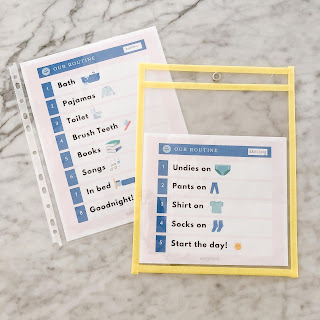


The first few times a visual routine is used, you will do it with the child and teach them the steps of the routine. However, after a few uses, they will be able to look at the chart and follow the routine on their own. Over time, they will internalize the routine and no longer need it. They will have learned the steps, and be able to navigate the process independently.

On the Earlybird platform you can find cut & paste versions of helpful visuals that let you personalize routines to your child, or you can print several of their premade routines for bedtime, laundry, morning, hand washing or learning to use the bathroom. Or, you can create your own visuals, perhaps using characters from your child's favorite book or video. 

Monday, November 29, 2021

Making Sense of Early Learning for Parents and Childcare roviders

Today we welcome back blogger Renée Jordan, who last wrote for us in 2016. We are delighted to have her contributing to our blog once again. Read about her story and hear about the exciting learning resources she has helped create.


I used to be a learning specialist at The Yellin Center. I eagerly joined the incredibly talented team as soon as I finished grad school at Columbia. My years at the Yellin Center are where I grew my knowledge of child development and how a child’s brain learns and grows. Working alongside Dr. Yellin deepened my understanding of the neurodevelopmental constructs that are fundamental to the work of The Yellin Center and my commitment to helping families and children make sense of their cognitive strengths and challenges to ensure they find success in school and beyond.

I left the team in 2016 to return to my hometown to focus on fertility treatments in hopes of starting a family. Leaving NYC and The Yellin Center was one of the hardest decisions we have made to date. But finally, in 2018, we welcomed our son Anderson. While on maternity leave, I began creating and doing easy activities with Anderson that targeted the core neurodevelopmental domains. When I began sharing them on Instagram I generated a following of fellow parents and childcare providers who were looking to make sense of the early years for their own kids.


It was during this time that I met Sarah, the other half of Earlybird. Sarah is an entrepreneur with a robust business knowledge and incredible sense of design. After we both had our second children, we decided now was the time to partner and build a platform outside of social media where parents and childcare providers could come to find the information they needed to know about child development, as well as the evidence-based activities and materials they needed to apply that knowledge. So in the middle of the pandemic, with four kids under three-years-old between us, we launched Earlybird.

Earlybird’s goal is to nurture every child’s intellectual, physical and social-emotional development to ensure they are ready for school and life. Anyone caring for children will find that Earlybird equips them with the confidence, knowledge and resources they need to create child-centered and developmentally appropriate play-based learning experiences that build a child’s literacy, numeracy, motor, social-emotional and creative thinking skills.

We keep it simple for you by using everyday items in our little to no prep activity ideas. On the platform you can filter resources by subject, specific skills, and ages. Then do the activities now, or save your favorites to your saved folder for later. We take the guesswork out of the early years for you.

Stay tuned for more posts looking at the research behind the early childhood tools we have developed. 

Monday, June 5, 2017

Research Links Screen Time with Speech Delays in Young Children

You see it all the time. Little children with their parents' phone, iPad, or other handheld device. The temptation for parents is understandable; keeping a young child occupied can provide the distraction to enable a parent to complete an errand, do a task, or just catch their breath. It's an understandable impulse, and one we have looked at previously.

But it's not a benign activity, and new research shows just how damaging handheld screen time can be to the expressive language skills of very young children.

The study looked at roughly 1000 children in the Toronto area, ranging from six months to two years of age. By the time they were 18 months old, their parents reported that 20 percent of the children had average daily handheld screen time use of close to 30 minutes. Based on a screening tool for expressive language delays, the researchers found a significant correlation between increased screen time and delays in expressive language. For every half hour increase in screen time with a handheld device, there was a 49 percent increased risk of expressive language delays. There did not seem to be delays in other forms of communication, such as body language or gestures.

This study is preliminary and the researchers emphasize that more investigation is needed. But the results are of sufficient concern that they should give pause to parents who are inclined to hand over their phones or tablets on a regular basis to entertain a fussy baby.

Friday, May 5, 2017

Why 3K For All?

New York City's Mayor Bill De Blasio recently made a very exciting announcement about early childhood – by around 2021, all three-year-olds in New York City will be eligible for free preschool. De Blasio rightly called this investment “one of the smartest we’ve ever made in the history of this city.” We don’t need another study reminding us that early intervention has an unbelievably high return on investment, both financially and with regard to student achievement. A few other cities in the country have already begun offering this service to families, but NYC will be the biggest district to do so.


To figure out why educating kids beginning at age three is so important, we just need to look at the amazing work done by The Carolina Abecedarian Project (ABC), a controlled study carried out in the 1970’s. Plenty of wraparound early intervention services continue to exist in a number of states, but there is very little research on the long-term effects of these services, and whether they are financially reasonable undertakings. A study published after a 30-year follow-up assessment of the children in the ABC project adds to the overwhelming evidence that success as an adult starts with high-quality care that begins at birth.

The children in the study received high-quality care all day starting at eight weeks old. Their mothers increased their earning power by receiving subsidized care, so they could invest more in their careers. The children were immersed in language and interactive play with trained educators. Parents also received tips and parenting instruction, while all the children had access to quality health care. The young children came out of the program with early literacy skills, self-control and self-regulatory skills, higher engagement with the environment, and a solid foundation for kindergarten.

After decades of follow-up, researchers believe that the financial return on investment is about 13%. That’s quite a bit higher than your typical investment in the stock market. The societal benefits top even that high number, with reduced crime, better health, lower drug use, lower blood pressure, more years of education, and larger contributions to the economy. Since the children had subsidized care, parents were able to go to work full time and experience true upward mobility. They found positive effects in maternal education, labor force participation, and parental income. However, the researchers specifically note that these effects are due to the high quality of the wraparound care provided, and that low quality childcare is likely to take a steep toll on children’s and families’ well-being.

Finding high-quality affordable childcare in New York City is, some would say, an impossible feat. We’re looking forward to seeing how the 3K For All plan unfolds over the next few years, and what effect is has on children and their families.

Wednesday, April 15, 2015

Bright by Three

There seems to be little doubt that, for many people, text messaging has become the most common means of communication. Phone calls have fallen by the wayside: If people want to convey a quick piece of information they seem to prefer typing it out to talking it out. This makes sense; texting is fast and easy and one can get and receive texts anywhere, even places where loud phone conversations are inappropriate.

A Denver non-profit called Bright by Three is taking advantage of the popularity and ease of text messaging. According to Bright by Three, 85% of a child's intellect, personality, and social skills are developed during the first three years of life. Since children aren't in school during this critical period, Bright By Three aims to help parents engage their little ones in ways that are proven to develop these important components. Last year, Bright by Three reached over 21,000 families in Colorado. But, thanks to text messaging, their reach can extend even farther.


Bright by Text is their latest innovation. Parents and caregivers anywhere can enroll in the program for free (though data rates may apply) by texting "BRIGHT" to 444999. They'll be asked for their child's age in months, and then the fun begins. Bright by Text sends weekly messages that correspond to the child's age and stage of development. Texts include learning games that develop physical and cognitive skills, health and wellness tips, and relevant information about child development and important milestones. Each text also contains a mobile-friendly link to additional resources. Bright by Text is available in both Spanish and English.

If you, or someone close to you, has a young child, we encourage you to take advantage of this free service. Tips are research-based and timely, and the format couldn't be more convenient for families on the go.


Wednesday, December 17, 2014

Kindergarten Readiness: A Framework from Sesame Workshop

Preparing children for school, and ensuring they have the skills required to be a successful learner, can be a challenge for every parent. Parents are often left wondering what abilities their child needs to have mastered before entering school, leaving them with high levels of anxiety about how to best prepare their child for school, and what the commencement of kindergarten will bring.

Sesame Workshop, the educational research organization behind Sesame Street, commissioned the Early Childhood Longitudinal Study to examine school readiness in today’s children. Their findings where released in the Kindergartners’ Skills at School Entry report in July 2014. The report reveals discrepancies in kindergarten readiness, with 44% of children entering school with one or more risk factors that have the potential to impact their success in school.

In response to the data and in acknowledgement of the anxiety parents face around school readiness, Sesame Workshop decided to make their personal Kindergarten Readiness Framework available to the public. This document is the culmination of over 45 years of their independent research on early learning. Previously, Sesame Workshop has used this guide as their internal framework to help ensure that the content they produce is developmentally appropriate and supports the educational growth of their young audience. The document is robust, and highly supported by current research.


It does an excellent job of breaking down and detailing twenty key school readiness skills that are thought to help promote success in school settings. Furthermore, each content area (language, math, science, health, emotional regulation etc.) is sectioned by age, and offers developmentally appropriate skills that a child should be achieving in years two through five.

Hopefully, this guide is able to answer some of your questions about kindergarten readiness, and the key skills your child needs before entering the classroom. However, it is important to note that children progress and develop at different rates. Therefore, if you find that your child isn’t preforming at a level described in the framework, don't  be alarmed. This is only a guide, not a diagnostic tool. It is also only one tool of many to help you determine your child’s readiness for school. If you are still left with concerns over your child’s kindergarten readiness, you should start by talking to your child's pediatrician about how your child is developing and acquiring skills.


Friday, October 10, 2014

Resources for Teachers: Sight Word Recognition Game

With this week's posts on The Yellin Center Blog, we welcome a new blogger to our Yellin Center team - Learning Specialist Renée Jordan, M.A. Ms. Jordan's blogs will include tools and techniques for teachers and parents that she developed as a classroom teacher, as well as reviews of apps, books, and other resources.

On a Roll
On a Roll is a game I developed as part of the language arts curriculum for my students in kindergarten and first grade. Sight words are a small group of words (approximately 300-500) that account for large portions of the common texts we read. For example, words such as: this, that, then, he, she, and etc are considered sight words. Due to their high frequency, it is critical that students cultivating early literacy skills develop their sight word recognition skills. 

Description of Game

On a Roll provides a fun, engaging way for students practice their sight word recognition. The game is fully customizable, thus allowing educators to alter the grid to include sight words that are specific to your students’ needs. Furthermore, peer collaboration is a great strategy for reinforcing learning. Therefore, having students work in pairs and use their peers as support when identifying sight words that challenge them will also be beneficial.

In my own classroom, I have used On a Roll as an independent, stand alone lesson, as an "early finisher" activity, and as one activity in my literacy centers. Furthermore, I found that my students really enjoyed and benefited from the activity and wanted to make permanent game boards for my classroom. As a result, I made multiple game boards with all the sight words I wanted my students to master by the end of the year and laminated them. My students were then able to use dry erase markers on the game boards, which were easily cleaned at the end of each lesson. 

Materials Needed
  • One handout per every two students. You can download the handouts here (for page 1) and here (page 2), or create your own.
  • 1 die per two students
Instructions
  • Pair students with a partner and distribute materials.
  • Explain the rules of the game and highlight the text at the bottom of the game board where the students can refer to the rules in case they forget.
Rules
  • Each partner will take a turn rolling the die
  • They will then find the sight word that corresponds with the number rolled
  • Then the student will locate the sight word on the game board and color it in
  • The first student to color in an entire row is the winner

Allow the students time to play the game. If time is left, have the students find a new partner and play again. Alternately, you could make multiple game boards with a variety of sight words your students need to master. Therefore, when they have completed a round of play they could attempt a new word list.


How this game aligns with Common Core Standards:

Wednesday, July 16, 2014

Read and Rise Program Cultivates Literacy

A meeting at The Yellin Center yesterday among educators and others looking to improve outcomes for young children in New York City's Harlem neighborhoods, gave us the opportunity to meet Shirley H. Smith, Ph.D., who serves as a consultant to Scholastic, Inc. Dr. Smith introduced us to Scholastic's Read and Rise Program, part of the Scholastic FACE initiative -- Family and Community Engagement. Read and Rise is one part of the FACE mission to work with families and community resources to build early language development and literacy skills in children and address the fact that some 35% of children begin school without the language skills they will need to succeed.


Read and Rise is designed to reach parents and caregivers to help them to build oral language and other pre-reading skills in their children by building on the child's primary language and familiar culture. Such basic everyday things -- reading aloud, sharing songs and stories, and talking about cultural traditions -- are emphasized as ways families can help prepare their young children to start school ready to learn to read. In fact, the program is based on research that demonstrates the impact of early language development and home environments rich in books and reading as factors in long-term academic success.

The program includes a workbook for parents of children from infants and toddlers through third grade, including stories to read aloud, suggestions for engaging children in reading, and recommended books. There are separate books to read aloud along with a guide for parents as to how to maximize the reading experience for their children. There is also a web version of the program as well as information on how community organizations can obtain grant funding to enable them to implement Read and Rise. 

Wednesday, May 7, 2014

Use of "Touch Screen Devices" by Toddlers

The  American Academy of Pediatrics (AAP) has long cautioned parents to limit media exposure of young children and updated their recommendations as recently as 2013.

A new study on this subject from a team led by Dr. Ruth Milanaik, an attending developmental and behavioral physician at the Cohen Children’s Medical Center of New York on Long Island, New York, looked at the very youngest children -- infants and toddlers up to age three -- to examine what the researchers called "touchscreen device usage" or TDU, to see how use of or exposure to such devices as smart phones and iPads impacts children's development.

Dr. Milanaik noted that the study was prompted, in part, by the observation that the "number one toy" that parents gave their children to play with at a newborn follow-up clinic was a smartphone. In an article on the study in Forbes, she noted that parents were substituting smart phones for books and other baby toys and stated, "Many parents did not seem to bring any other distraction for their children except the touch screen devices.”

The study found that the majority of parents questioned believed that TDU had educational benefits. However, developmental scores showed no significant difference between children who had access to such devices and those who did not. Furthermore, children who played non-educational games (such as Angry Birds or Fruit Ninja) on touchscreen devices had lower receptive & expressive language scores compared to children who engaged in other types of TDU. The authors caution that it is possible that children with slower language development may prefer playing non-educational games and that it would be inappropriate to conclude that lower scores in language were caused by TDU.

Dr. Paul Yellin commented,  "Dr. Millanaik’s quote may get to the heart of the matter. It may not be the devices per se, but rather the fact that they are used instead of reading or speaking to children. This is consistent with recent research demonstrating the importance of exposure to language in the early years."


Monday, April 7, 2014

This Friday, April 11th, Dr. Paul Yellin will be the Keynote Speaker at a forum titled Silent Crisis: The Impact of Chronic Stress and Trauma on Early Childhood Learning and Development. His presentation will look at a number of important considerations in the emotional, cognitive, and behavioral development of children under stress from the environment in which they live.


Starting with the famous "marshmallow experiment" and its follow-ups, he will look at how children's impulses are shaped by whether they have - or don't have - a reliable, trusted adult in their lives. He will discuss how early language skills are acquired and the importance of exposure to language in this process. He will then proceed to look at how the developing brain is impacted by stress, using images of brains in different circumstances to clarify his examples. 

Dr. Yellin will then speak about  neuroplasticity - rewiring our brains - to see how this ability is part of resilience, the ability to bounce back, recover, and ultimately overcome adversity. When children have a "turnaround" person in their lives, they are often able to succeed even if their early development was fraught with stress and lacked the language input and emotional support that is optimal for brain development. 

This event, with other speakers including Aletha Maybank, MD, MPH, Assistant Commissioner of the Brooklyn  Public Health Office of the NYC Department of Health; Evelyn K. Blanck, LCSW, from the NY Center for Child Development and Renee Wilson-Simmons, Dr.PH, Director of the National Center for Children in Poverty, is co-sponsored by Healthy Start Brooklyn, Central Harlem Healthy Start, and Columbia University Mailman School of Public Health Downstate New York Healthy Start, in collaboration with the Northern Manhattan Perinatal Partnership.

The forum will be held at the Oberia Dempsey Mult-Service Center, 127 West 127th Street in Manhattan and admission is free and open to the public. It begins at 9 a.m.


Monday, September 9, 2013

Learn With Games Instead of Drilling

Parents often ask us for advice about their kids’ schedules. They understand the value of raising well-rounded kids who also get the outside academic support they need, but how much tutoring can they cram in around guitar lessons, swim practice, and choir rehearsal? And what about the all-important decompression time kids need, to go about the business of being kids?

For children who need some extra practice with reading and math skills, particularly in kindergarten and the early years of elementary school, these questions can be tough ones. One possible solution is to multitask. Wouldn't it be great if your child could play and learn at the same time? If this idea appeals to you, then Peggy Kaye’s books could be great resources for your family.

Games for Reading and Games for Math have been around for a long time (first published in 1984 and 1987 respectively), but Kaye’s delightful outlook and thoughtful, fun suggestions are timeless. Kaye believes that “what doesn't amuse shouldn't be used,” and she encourages parents and teachers of students in kindergarten through third grade to experiment with her many great ideas until they find some that get kids smiling so much they won’t even know they’re building critical academic abilities.

Games for Reading hones a variety of reading skills. For example, Wrong-Speed Conversations counsels parents to speak to children as though they’re faulty record players, speaking much too quickly or much too slowly. When children get over their fits of giggles and are encouraged to do the same, their slow-motion speech helps them to stretch out words and pay attention to the individual sounds that make up each word, a critical skill for early literacy and spelling. Similarly, rhyming games in which one “player” begins a rhyming couplet but leaves off the last word for the other person to finish (“I could eat two/But I’d rather share one with ____”) develops phonemic awareness, helping children to be more attentive to the sounds in words. Kaye has more ideas for working through stacks of flashcards than you thought could possibly exist, and many of her games involve friendly competition, jumping, and drawing. The List of Important Sounds at the back of the book helps parents who are not educators to ensure they’re hitting all the critical bases when they plan games at home.

Games for Math is another gem. Kaye’s Cleaning Counts game, for example, turns clean-up time into a math lesson. Instead of simply saying that you want your child to clean up her toys by the time you count to 20, why not experiment by counting backward or skip counting by 5’s to 100? Invite your child to count with you as she starts to get the hang of it. Kaye points out that this kind of early exposure to number patterns is a great way to build a child’s awareness of numerical sequences. Kaye also shares ideas for card games that will help children practice addition and homemade tangrams and visual puzzles for spatial reasoning. And her drawing game on graph paper for understanding multiplication is simple yet nothing short of brilliant.

Students need free, unstructured time to engage in creative play. But thanks to Games for Reading and Games for Math, the fun doesn't need to stop when it’s time to review academic skills.

Wednesday, August 7, 2013

Beast Academy Helps Elementary Students Learn Math

Problem: Your elementary school-aged child is hooked on comic books instead of on her math book.

Solution: Give her the Beast Academy books by Art of Problem Solving.
Beast Academy

New Problem: Your elementary school-aged child is staying up past her bedtime to sneak more math problems.

Solution: …we’ll have to get back to you on that.

The Art of Problem Solving provides math enrichment activities and instruction for high-performing middle and high school students. It publishes its own line of math textbooks and also has a website where students can interact with a large community of other math lovers, play math games, view video lessons, and more.

With its new Beast Academy books, Art of Problem Solving has expanded its offerings to younger students. The books, designed for kids in 2nd-5th grades, are divided into four levels, from 3A (shapes, skip counting, perimeter, and area) to 3D (fractions, estimation, and area). There are both guide books and practice books available for each level.

The books cover the concepts mandated by the common core curriculum. But that won’t matter to your child. What will matter is that he won’t be able to get enough of them. In the guide books, concepts are introduced and explained by a group of colorful beasts whose color, size, amount of hair, and number of appendages varies. They are friendly and appealing, and they narrate lessons that are presented in comic-style frames. The graphic format allows plenty of opportunities for characters to point to different parts of, say, a number line or a fraction, as they explain the concepts. And because the lessons are presented as dialogue, students are privy to the beasts’ thinking processes as they reason through problems and concepts. The practice books provide problems so students can put their new know-how to work. Beasts from the guide book appear in the practice books, too, offering tips and instructions at the top of each page, which makes the pages feel familiar and accessible and less like a typical homework assignment. As in the guide book, instructions and examples are very visual.

If your child is bored with standard math instruction, struggling in math, captivated by comics, or particularly receptive to visual material, these books are certainly worth investigating. They would serve as great end-of-summer reads, too; children may enjoy reading the appropriate Beast Academy book before the school year begins to introduce them to important concepts they’ll cover in the next grade. Parents can visit the Beast Academy website  to see sample pages from both guide and practice books, as well as learn more about the series and access free, printable pages.

Monday, May 13, 2013

Poetic Language for Tots

Chris Drumm
When it comes to reading poetry with kids, start young! Even little ones who are still developing language can benefit enormously from hearing poetic language. The rhythms and rhymes in poetry draw kids’ attention to the sounds and patterns in English. This translates to oral language development, and to an important awareness for language sounds (called phonemic awareness) that’s a precursor for reading skills. Exposure to poetry builds vocabulary as well. But perhaps most importantly, poetic language written with kids in mind encourages children to be playful with language and emphasizes the fun aspects of literacy. Milton and Chaucer use some great poetic language, but if you’d rather start your little one with something a bit more child-friendly, here are some ideas:

  • Read nursery rhymes to your kids. The simple language is full of appealing rhythm and rhyme. 

  • Sing songs like Raffi’s "Willoughy Wallaby Woo" or "The Name Game." Kids will get some great practice with a skill called phoneme manipulation; that is, they’ll practice substituting sounds in words to make new words, which is important for developing reading skills later. They’ll get a good giggle out of using their names and names of their friends and family in the songs, too. 

  • Tongue twisters aren’t exactly poetry, but they help hone kids’ attention to language sounds. Try "Peter Piper" or the classic woodchuck twister, or challenge your kids to say, “She sells seashells by the seashore.” 

Monday, April 15, 2013

Early Exposure to More Words Leads to Academic Success

Head Start, the iconic preschool program begun in 1965, aims to erase the achievement gap between affluent children and poor children by providing preschool services to vulnerable populations. But erasing this gap has proven to be difficult.

A recent article in The New York Times looks at an exciting program in Rhode Island called Providence Talks, which builds on research published in 1995 by the late Drs. Betty Hart and Todd R. Risely, which suggested that children from wealthier families tended to outpace their lower-income counterparts even before preschool began. Providence recently won the $5 million Bloomberg Philanthropies’ Mayors Challenge for its proposal to build on Hart and Risely's findings to use a network of nurses, mentors, therapists, and social workers to teach pregnant women and families with new babies the importance of exposing their youngsters to lots of words.

Hart and Risely found that the critical difference between children from higher and lower income groups was how much parents talk to their children from birth to the age of three. In a study designed to investigate how parents at different income levels talked to their babies, they stumbled upon the realization that what really mattered was how much parents talked. Kids who did better in school by the age of nine had parents and caregivers who talked to them a great deal. Further, the amount of talk seemed to be more important than the type of talk.

Hart and Risely found that the number of words children heard seemed to vary a great deal by income level. Children whose families received welfare heard about 600 words an hour, compared to 1,200 words for babies in working-class families and 2,100 for babies in professional families. (Talk heard on television didn't count; in fact, television exposure appeared to be detrimental to students’ IQ and school performance.) According to Hart and Riseley’s results, at those rates a poor child would have heard 30 million fewer words by the time he or she turned three. Their findings indicated that increased exposure to words was associated not only with stronger vocabulary, but also with higher IQ and school performance. Provocatively, Hart and Risely argued that the correlation between word exposure and academic success was so close that if all children were exposed to the same number of words during the first three years of life the income gap would disappear entirely.

A summary of Hart and Risely's research findings entitled The Early Catastrophe includes a number of compelling charts.

This issue isn't new; we wrote about the importance of talking to your children just over two years ago, noting how parents and caregivers engaged with their cell phones are missing opportunities to speak to their child. Sometimes the research findings we report are difficult to replicate at home. Hart and Risely's findings are easy to apply. Talk to your child - early and often.


Wednesday, January 16, 2013

New Apps and Tools for Students: Graphing Calculator and V.Reader

An iDevice app for advanced math students and a "kiddie Kindle" for early readers are two of the many new ways that technology can help students of all ages.

For Advanced Math Students: Graphing Calculator


This news might make you feel a little bit better about breaking down and buying your child that iPhone he or she has been begging for: Thanks to the app Graphing Calculator by Appcylon, there’s no need to shell out another $150 for that powerful, essential accessory to all advanced math courses. For just $1.99 from the iTunes store, Graphing Calculator does all that a standard graphing calculator does, and does it better, too. The display is sharp and clear, lines can be presented in different colors, and the interface is streamlined instead of being clunky. Graphing Calculator works on all iOS devices.

A word of caution, though: Be sure that your child’s school will allow him/her to use a phone/iPad/iPod Touch in class and on tests before relying solely on this app for all calculation purposes.


For Beginning Readers: V.Reader


Think of Vtech’s interactive e-reading offering as a "kiddie Kindle" -- kids read downloaded electronic books on its high-resolution screen, look up words they don’t know, and much more. The device is rated for users from age 3-7, so while pre-readers can choose to have stories read to them and enjoy the animated pictures that accompany the words, beginning readers can read the stories themselves. V.Reader also features a helpful tutorial function in which tapping a word with the stylus or just a fingertip provides the reader with a definition or help sounding the word out. Kids can play games or create digital artwork as well, and a tracking mechanism allows parents to monitor their kids’ progress. New e-books can either be purchased in cartridge format or downloaded via a computer and transferred to the device. The V.Reader is made of durable plastic and comes in either pink or blue, and parents will be relieved to know that they can silence the beeps and whistles typical of children’s electronic games by plugging their tots into the headphone jack.

The downsides are few, but are worth pointing out. For one, the V.Reader plows through batteries – it requires 4 AA’s to run – so investing in a battery charger may be wise if you buy a V.Reader for your child. Additionally, the stylus is not tethered to the reader and can be easily lost, so it may be a good idea to require that it live in a special place while not being used. Overall, however, reviews of the V.Reader have been overwhelmingly positive. Kids seem to love it, and parents report that they are seeing literacy progress. At $39.99, the V.Reader is a good deal, one parents will appreciate even more when they don’t have to read the same bedtime book to their little one for the tenth night in a row.

Monday, October 15, 2012

The Marshmallow Task: A New Perspective

Most, if not all of you, have heard about the ‘marshmallow task’ experiments conducted at Stanford University back in the 1960’s. In the experiments, a group of three-to-five-year-olds were given a choice. They could either eat one marshmallow immediately or wait 15 minutes and eat two marshmallows. In that study, the ability to wait for two marshmallows correlated with long-term success. The implications seemed obvious. Children with self-control early in life tend to succeed. I have heard some educators argue that the marshmallow task should be used in the admission process for competitive private schools. Others have suggested that the study demonstrated that people are poor because they lack self-control.


However, a study just published online in the journal Cognition by Celeste Kidd, a doctoral candidate at the University of Rochester provides a new perspective on this classic study. In her study, Kidd points out that the common interpretation of the classic marshmallow study is based on the assumption that waiting is always the best decision. But what if waiting is not the best decision? What if you can’t trust the adult making the promise and you don’t believe that they will actually deliver on their promise? Then, grabbing the marshmallow when you can is actually evidence of rational thought -- not impulsivity!

In the Kidd study, prior to beginning the marshmallow task, the children are provided evidence of the experimenter’s reliability. When children believed that the experimenter was reliable, they waited four times as long as those who thought that she was unreliable. In other words, children’s actions are influenced by their perception of the reliability of others' behaviors. While Kidd’s work does not mean that self-control is not relevant, it does strongly indicate that it is premature to conclude that self-control early in life is the major determinant of long-term success. When children cannot trust the adults in their life, seeking immediate gratification makes sense.

What is the take-home message? Children need the adults in their lives to be trustworthy, caring, and reliable.

Learn more about the Kidd study in the following video by the University of Rochester:


Friday, August 31, 2012

Early Skills Can Predict College Success

A study by a team at Oregon State University led by Dr. Megan McClelland and published in Early Childhood Research Quarterly found that children who had greater attention spans at age four had an almost 50% higher likelihood of completing college by age 25. The researchers looked at 430 children and, after controlling for such variables as family background, gender, and early academic achievement levels, found that strong early attention abilities also predicted math and reading achievement at age 21.

That's all well and good, but if attention spans in young children are so important, can anything be done to build such skills in children who lack them?

The answer may lie in the games some of us remember from childhood -- games like Simon Says and Red Light, Green Light. An earlier study of 65 preschoolers found that when children who had low levels of focus played games similar to these they demonstrated improvements in both early language skills and self-regulation.

A review of this topic by New York Times writer Tara Parker-Pope notes that the most effective way to to use games to build skills in young children is to begin with games with simple rules and to make them increasingly complex. For example, the games used in the Oregon research included a variation of Simon Says that started with copying the leader's movements but then required the children to do the opposite of what the leader did --such as touching toes when the leader touched her head. Other games that were found to build attention and executive function skills were singing in rounds and playing "Red Light, Green Light" using red for "go" and green for "stop." Try these. They are harder than you would expect.

Friday, August 17, 2012

Study Links Early Snoring to Behavior Problems

A sleeping toddler snoring away may seem cute to parents and other observers, but a new study in the journal Pediatrics raises concerns about the impact of sleep-disordered breathing (SDB) -- loud, persistent snoring -- on the future development and behavior of children.

Researchers enrolled 149 child/mother pairs in a prospective study that tracked snoring through the child's third year and categorized the children as non-snorers, transient snorers (who snored at age two or age three but not both) and persistent snorers.The choice of the age group of two to three years was based upon the fact that SDB is known to peak during this period.

The study found that there was a significant increase in behavior problems in the group with persistent SDB even when adjusting for such factors as gender, race, and socioeconomic status. These behavior problems included hyperactivity, depression, and attention. The findings of this study are consistent with findings of studies looking at older children and which hypothesize that the interruption in sleep caused by SDB can interfere with neurological development.

Two other significant findings in this study were that children who were breast fed were less likely to have SDB and that a low socioeconomic level made it more likely that a child would have transient or persistent sleep disordered breathing. None of the children who were fed breast milk for more than a year developed SDB but one-quarter of those who never were fed breast milk or who were fed it for less than one month developed SDB.

The study authors note that interventions to treat snoring have been shown to be helpful and urge that children be screened for sleep disordered breathing. They also stress the positive impact of breast feeding and urge that parents consider this protective factor when making feeding decisions.


Photo: Elizabeth / Creative Commons (modified)

Thursday, April 12, 2012

Teachers College Opens Academic Festival to the Community

On April 21st, Teachers College will host its fourth annual Academic Festival. This year’s offerings will center around the theme “Rewiring the Learning Landscape.” Various panels will explore technology and its effect on education and the world at large. Topics will include online communities, social media and adolescence, teaching financial literacy, and virtual access to art.


Though most of the day will focus on lectures and panels more appropriate for adults, there are opportunities for kids to have fun, too. For those with young children, WeBop is sure to please both you and your little one. Come learn about this early childhood jazz education program, designed for kids ages 8 months to 5 years. Families can learn about instruments used in jazz and explore the musical genre, as well as express themselves together through dance! (Watch the video below for more about WeBop.)


Kids ages 6 and up are also welcome to enjoy a cooking demonstration and food sampling hosted by nutritionist Pam Koch.

Visit the festival webpage for detailed information about the agenda and other useful information.

Monday, March 12, 2012

"Redshirting" -- Holding Back Younger Children

New research on diagnosing younger children with attention issues has come out at the same time that media sources have drawn attention to what is sometimes called "redshirting" - the practice of holding younger children out of kindergarten for a year so that they do not move through school as one of the youngest children in their class.

In an article in the Journal of the Canadian Medical Association, researcher Richard Morrow of the University of British Columbia and his colleagues looked at more than 900,000 Canadian children over an 11 year period. The cut-off for enrollment in kindergarten in Canada is December 31st. The oldest children in any given kindergarten class will have January birthdays and the youngest children will have been born in December. Morrow and his team noted that children with December birthdays were 39% more likely to be diagnosed with attention deficit hyperactivity disorder (ADHD) and 48% more likely to receive medication to treat ADHD. Furthermore, the likelihood of diagnosis and treatment decreased with each month of age -- so children born in March, for example, were less likely to be diagnosed and treated with medication than children born in October. This study raised concerns both about the rate of diagnosis and the impact of treating young children with ADHD medications. As quoted in Time Magazine, Morrow noted, “What is clear from our study is that younger children in a classroom are more likely to receive a diagnosis of ADHD and drugs to treat that ADHD... but their relative maturity should come into play. Something to keep in mind when we look at behavioral problems is whether the behavior relates to differences in age and maturity.”

The social, academic, and even athletic consequences of holding children back was the topic of a recent segment on 60 Minutes. What was apparent from the piece was that parents had a variety of reasons for holding children back. Some did it because they felt their child needed more time to mature. Others wanted to give their child an academic advantage and still others wanted their child to have additional size and coordination for future athletic endeavors. What was noted by the correspondent was that parents who were holding their children out of kindergarten were generally affluent; families with fewer resources or where both parents needed to be in the workforce could not afford the additional year of nursery school or child care that comes with the decision to hold back from kindergarten enrollment. The segment also highlighted parents who felt strongly that holding their child back from kindergarten was both unnecessary and fundamentally unfair to other children.

The American Academy of Pediatrics has taken the position that schools need to deal with children at all levels of school readiness and that parents, communities, and pediatricians need to work together to make sure that all children are ready to begin school with the tools to succeed.

Perhaps the best perspective on this issue is one we heard from a parent who faced this question when her now adult children were of kindergarten age. Both children, born two years apart, had November birthdays in a district where the cut off date for kindergarten was December 1st. She and her husband decided to keep one child on track and he entered kindergarten as one of the youngest in his class and remained so throughout his school career. They decided to hold another child back for a year, and he entered kindergarten and moved through school as one of the older students in his class. "In each instance," she noted, "it was the right decision. I don't think there is one right path, just what seems to be the right path at a given time for a particular child."