Showing posts with label tips for teachers. Show all posts

Wednesday, May 15, 2019

Skip-Counting – The Threes & Sixes, Plus a Game

Today's post winds up our "From the Trenches" series by Colorado classroom teacher and former Yellin Center Learning Specialist Beth Guadagni. In Beth's prior posts, she explained how our brains learn math facts and how she uses songs to help her students -- all of whom have dyslexia -- learn the fours multiplication facts.

Our last post gave background and instructions for teaching multiplication facts for four and eight. Using different songs, Beth explains how the same techniques can be used to teach the math facts for threes and sixes.

Skip-Counting by Threes

“Three” is repeated three times to get the rhythm to work out. We add “and thirty-six” at the end in the same way people add “and many more” to the “Happy Birthday” song. Jazz hands, while optional, are highly recommended.

Row,                   row,                      row                      your                     boat,

Three,                 three,                   three,                   six,                        nine


Gently                down                    the                       stream,

Twelve,               fifteen,                   
eighteen                        


Merrily,             merrily,                   merrily,                 merrily,

Twenty-one                 Twenty-four                   Twenty-seven


Life is but a dream.


Thirty   thirty-three


…and thirty-siiiiix!


Skip-Counting by Sixes


Happy                birthday                to                     you,

Six                      twelve                    eighteen          twenty-four


Happy                birthday                to        you,
thirty                  thirty-six               forty-two


Happy                birthday               dear           [name]

Forty-eight               and                 fifty-four


Happy                birthday                 to you!

Sixty                   sixty-six                 seventy-two!

Game: Domino Draw

Purpose:
To give students practice applying skip-counting sequences to real math problems.

Materials for the game:
A set of dominos, turned face-down or in a bag.
Procedure:
If you don’t plan to play long enough to go through a whole set of dominos, use a timer so that students play for a set amount of time. Be sure, once it goes off, that everyone has had the same number of turns.
There are two variations here.

1. To target the sequence students are learning:
On his turn, each player draws a domino at random. He adds the number of dots on the domino, then multiplies that number by the sequence you’ve been practicing. For example, if his domino had 11 dots on it and you were practicing the threes, he’d get a product of 33 and earn 33 points.

2. Once students have learned all the sequences, try this variation:
On her turn, each player draws two dominos at random. She adds the number of dots on each domino, then multiplies them together. For example, if one domino had four dots on it and the other had twelve, she’d get a product of 48 and earn 48 points.

Wednesday, May 8, 2019

Skip-Counting by Fours ... And a Multiplication Game


In her last post, Colorado teacher Beth Guadagni shared the concepts behind one of the methods she uses to  help her students (all of whom have dyslexia) learn number sequences. As part of her advice "from the trenches" we share the specific techniques that she uses in teaching them to work with fours, getting them ready to do multiplication and division. 

Purpose:
To help students memorize number sequences that will help them with multiplication and division.

Procedure:
First, make sure the students know the song. I like to start with the fours and use "Take Me Out to the Ballgame"  because the rhythm of the song fits perfectly with the number sequence, which is not always the case. Don’t try to teach the whole song-number connection at once! I usually like to start with the first five or six numbers, or the first two lines. In this case, the song breaks nicely after 28.

1. Write out the numbers from 4-28. Sing the first line and then ask the students to repeat it. Do this a few times.

2. Next, ask the students to close their eyes. Cover a number, then ask them to open their eyes. They should sing the line, filling in the missing number when they get to it. Do this a few times, covering different numbers each time.

3. Once they seem to be comfortable, add the next line of the song and repeat the procedure.

4. Cover or erase all of the numbers in your chosen lines and sing through them with the students once or twice.

5. Ask students to write the sequence as far as they’ve learned it.

For additional reinforcement, I like to hand out a sheet on which I’ve written the sequence they’ve learned a few times. Each time, it is missing more and more numbers. They have to complete the sequence by filling in the missing numbers, then cover the top part of the sheet when they’re ready to tackle the next, more challenging section. At the end of the sheet, they have to write the whole thing from memory. I also like to include a few multiplication and division problems from that family that they have to solve, using the memorized sequence to help them. They are not allowed to peek at the sequences from the top of the sheet unless they’re really stuck!

Teach the whole song, bit by bit, this way until you’ve taught the whole thing.

Take            me              out                    to the                     ballgame, 

Four          eight            twelve                sixteen                    twenty 


Take me out                to the crowd, 

Twenty-four               twenty-eight 


Buy me some                 peanuts and                      cracker-jacks, 
                             Thirty-two                      thirty-six                          forty 


I don’t care                           if                           I ever get back…. 

Forty-four                   and                            forty-eight

 
Once they’ve memorized the song, there’s one more part to add: students have to count on their fingers while they sing it. (I allow my too-cool high school students to keep their hands on their laps, as counting on hands that are held in the air feels babyish to some of them.) This is essential if they’re going to use the song to solve math problems.

Each time they say a number, they have to hold up another finger, so that by the time they get to, say, “thirty-six,” they are holding up nine fingers and will know that thirty-six is the answer to four times nine. This is trickier than it sounds. At first, when they have to both sing and track on their fingers most kids lose their place in the sequence. To practice this skill, we sing the song until I call out “Stop!” and students have to write down the last math fact they sang. For example, if I stopped them right after they said “twenty-four,” they should have six fingers extended and so they’d write “4 x 6 = 24.”

Why This Works:
Songs are incredibly powerful mnemonics. Most students seem to remember tunes easily, and this prompts them to recall the number that goes along with each change in tone and matches the number of syllables for that particular line. Students see the number sequence while they are hearing the sequence and the song, meaning that they store the information in several formats in their memories. Eventually, they count on their fingers while singing as well, adding a tactile element. Teaching the song in segments is quite important, too; as with any new skills, students must demonstrate mastery before they can tackle new material.

Once students have gained some comfort with skip-counting, you may want to introduce a game to help reinforce their skills. My kids like the card game "War".

Game: Multiplication "War" 

Purpose:
To give students practice applying skip-counting sequences to real math problems.

Materials for the game:

One or two decks of cards (Use two decks shuffled together if you’re playing with three or more students)
Procedure:
  • Ace = 1
  • Jack = 11
  • Queen = 12
  • King =0

Because War can take ages to wrap up, I often set a timer for around seven minutes while my students play, and the winner is the one with the most cards when their time is up.

There are two variations here.

1. To target the sequence students are learning:
Each player lays down a single card, face-up. They have to multiply the card by the sequence you’ve been practicing and say the product aloud. The player with the highest product keeps the cards from that round.

2. Once students have learned all the sequences, try this variation:

Each player lays down two cards at once. The player with the highest product gets to keep all the cards from that round.

If two players get the same product, they lay down two cards face down, then use a second pair to get the tie-breaking product.

Why This Works:
Students who aren’t focused don’t learn well, and games keep kids engaged in the learning task. This game is fast-paced enough to ensure that students have to use the skip-counting sequences they’ve learned many times during the allotted interval.


Friday, May 3, 2019

Strengthening Paired Associate Memory with Song

We are continuing our series of posts by Beth Guadagni, who shares the strategies she uses teaching her students with dyslexia in Colorado. 

Like many students, mine have struggled to learn their math facts. Automaticity with the multiplication tables is essential for math far beyond simply multiplying numbers; students use multiplication when working with fractions, doing long division, calculating area and volume, and in so many other applications that it seems rather silly to try to list them!

Perhaps most importantly: students need to have a sense of multiplication to determine whether a solution to a math problem makes sense. As Dr. Yellin will tell you, memorizing math facts involves a particular part of memory called paired-associate memory. Paired associate memory involves linking and storing two related data bits, retrieving one piece of information when presented with the other piece (eg., a sound with a symbol, or the number 28 when presented with 4x7).

Paired-associate memory is what we use when we learn someone’s name, remember that the color of the sky is called “blue,” pair the /ch/ sound with a "c" and an "h" together, etc. There’s no immediate context for these associations (although savvy students and educators can invent contexts to make information “make sense”); they just have to be memorized. Paired-associate memory is generally not a strength for dyslexic students, like mine, although people who don’t have dyslexia may struggle with this skill as well.

I learned skip-counting songs from a colleague and was amazed by the ease with which her fifth graders learned the number sequences. I was eager to try this concept in my class, but I was a bit apprehensive, too. Would my high school students be willing to sing strings of numbers to the tune of “Twinkle, Twinkle Little Star” and “The Wheels on the Bus”? The answer was a resounding “yes!” Although they were a little hesitant at first, my students were as pleased as I was that they could commit number sequences to memory with only a little practice. In fact (and this is true), one day one of my students, frowning darkly, exploded, “I’m really mad that I made it to eleventh grade before anyone taught me this!”

I’m going to spread the sequences over a few posts, which also is what one should do when teaching these songs. I’ll share a game for practicing math facts in each post, too. Learning the songs is important, but it’s not enough; one has to practice using the sequences to answer actual math facts, too. We'll present detailed instructions on how to use this technique in your classroom in our next post, but you can get a sense of how this process sounds from this YouTube video, posted by another teacher who used this technique. 


Friday, September 14, 2018

The Importance of Waiting

We often suggest that the teachers of students with whom we work take a moment to pause after asking a question in the classroom. This gives all students -- not just those who may struggle with retrieving information from their long-term memory -- a chance to process the question, consider the answer, and come up with the right words to respond. Even just a few seconds can make a big difference to a student with memory issues or expressive language difficulties or even just a student who is a bit shy.

Sometimes, the silence that ensues can be uncomfortable for students and instructors alike. However, according to Professor Bob Kegan of the Harvard Graduate School of Education, it's important for teachers to resist filling the silence by repeating the question or even providing the answer. Professor Kegan explains, in an excellent video that can be accessed on the Instructional Moves website, that making waiting time part of the class discussion and explaining to students why you are doing it, helps avoid confusion and emphasizes the value of time to think before responding.

It's worth trying this in your classroom.

Wednesday, November 16, 2016

New Attention Being Paid to Attention

When might a student’s focus be more likely to drift to the window rather than stay with the task at hand? Would it be when the material is easy or when it is difficult? A new study set out to explore and build on past research regarding this question.

Psychologists at the University of Illinois presented subjects with math problems to solve while pictures of neutral scenes, as potential distractors, flashed on a computer screen. As indicated by eye-tracking devices, participants who were given only easy problems to solve (Group A) were more likely to look at the distractors. In contrast, participants who were given only challenging problems (Group B) were less likely to look at the distractors. Financial incentives were incorporated into a variation of the experiment, but they seemed to have little impact. The more challenge that the participants encountered when working on the problems, the less likely they were to be distracted, regardless of financial incentive. 

Some participants were presented with a mix of easy and hard tasks. How distractible they were at any given time did not correlate with the difficulty level of the particular problem they were working on then. In other words, it seemed to be participants’ overall level of engagement with the task, rather than the difficulty level of any particular item, that accounted for the differences in distractibility between Group A and Group B.

The results suggest the importance of making sure that students are cognitively engaged. It is not enough to identify and assist students who may be struggling with coursework; it is also important to identify, and find ways to stimulate, students who may be bored with material that is not challenging them enough.

Friday, April 29, 2016

How to Achieve Transfer

Transfer, the ability to apply learning to a novel situation, is a tricky thing. It’s not so hard for students to memorize, say, the definition of “subject” and “predicate” when working in a grammar textbook. Grammar exercises, however, are futile if students continue to produce incorrect sentences in their own writing because don’t know how to apply what they learned on a worksheet. Without being shown how to use new knowledge in other contexts, many students struggle to recognize how a concept can be applied to a slightly different problem or task. This is a very inefficient way to learn. Students who don’t understand how to transfer what they learn must memorize hundreds and hundreds of discrete skills rather than just a few core ones.

In response to the excellent publication from Deans for Impact, The Science of Learning, we have a few ideas about how to ensure that students can transfer what they’re learning to solve problems in all kinds of contexts.


Find Similarities Between Tasks that Appear Different on the Surface

In our own practice, we’ve observed that findings by Richland, Zur, and Holyoak (2007) hold true: students can transfer their knowledge and skills to new situations if they’re able to figure out what the new situation has in common with tasks they’ve already navigated successfully. For example, some kids would have a tough time determining what the following word problems have in common:
  • Ryan sells 14 candy bars that cost $1.25 each. How much money does he collect?
  • If each of the 5 players on a basketball team scores 8 points in the game, how many points does the team score altogether?
  • A baker can decorate 40 cookies each hour. How many will he frost during a four-hour shift?
Many students struggle to know which operation to use in word problems because each scenario seems completely different. The problems above may seem disparate because one is about money, one about baskets, and one about cookies. In fact, though, each can be solved through multiplication. Comparing the problems can help students find similarities. Observant students, for example, might notice that “each” is repeated in all of the problems above. This word often signals multiplication. Students may find it useful to keep a sheet of notes on key words and the operations they often indicate.

Identify the Steps in a Multi-Step Procedure

Catrambone (1996 and 1998) suggests that students label the steps in multi-step procedures, such as conducing experiments, solving complex math problems, or writing. Such labels make it easier to compare the approach needed to work through similar tasks that appear different on the surface.

Producing a piece of academic writing is one of the most complex multi-step tasks asked of students. Generally the student must establish an argument, provide and explain evidence, rebut conflicting arguments, and all the while relate each point to the main point. Comparing one essay with another, though, might confuse some students. If one piece is about the use of allusion in a poem and another about the merits of recycling, what could the essays possibly have in common? Challenging students to label the steps each author conducted (stating thesis, referring back to thesis with each topic sentence, providing evidence, explaining evidence, etc.) makes it apparent that good essays, no matter the topic, have a lot more in common than might appear. Identifying the steps used to complete a task make the similarities between different tasks stand out, helping students to recognize how they can use the steps they already know to accomplish novel outcomes.

Provide Both Concrete Examples and Abstract Representations

Students often understand concrete examples best, but concrete examples can be hard to generalize so that the principles in them can be applied to other scenarios. Goldstone and Son (2005) found that learning is maximized when students are given a combination of concrete examples and abstract representations. The best learning outcomes occurred when students were exposed to concrete examples first, then gradually introduced to the abstract principle. Deans for Impact states that a combination of concrete examples and abstract representations “help students recognize the underlying structure of problems.”

To use this principle in a physics class, an instructor might begin teaching the concept of momentum by assigning the following word problems (i.e. concrete examples) and asking students to find the answers:
  • Find the momentum of a 7-kilogram bowling ball traveling 17 MPH.
  • Find the momentum of an 85-gram marble traveling 17 MPH.
  • Find the momentum of a 450-kilogram car traveling 20 MPH.
  • Find the momentum of a 283-ounce matchbox car traveling 20 MPH.
Next, the teacher should provide the following definition and formula:

“Momentum is determined by the mass of an object and its speed. The formula for calculating momentum at a given moment is p=(m)(v), where m=mass and v=velocity.”

Most textbooks provide concrete examples and formulas, but few ask students to do the work of defining the relationship between the two. This is where lasting, transferable understanding is formed.

In our example of the physics class, the instructor must help the students to see the relationship between their answers to the concrete scenarios and the abstract principle that defines momentum. Ideally, students will come up with a statement defining the relationship between the two, such as, “More mass and/or higher velocity results in more momentum. When mass, velocity, or both are decreased, momentum decreases.” That is transfer at work.

Wednesday, April 27, 2016

Supporting Anxious Children

While collaborating with fellow teachers in different parts of the country, your blogger has noticed a common theme: anxiety in students is becoming a much more salient issue in today’s classrooms. Data supports the notation that anxious tendencies in children is on the rise; a study conducted by the National Institute of Mental Health found that 25.1 percent of kids 13-18 in the United States have been diagnosed with anxiety disorders. 

Many colleagues have shared that they feel ill equipped and under prepared to mitigate these types of social-emotional and behavioral challenges. But behavior and self-regulation aren’t the only concerns teachers or caregivers are faced with when supporting children with mental health issues. Students who are dealing with psycho-social stressors often struggle to focus on their learning and their academic performance often wanes as a result. For example, a study published in the Journal of Abnormal Child Psychology surveyed a group of 1,197 students without a diagnosed reading or math disability. The students who were diagnosed with an anxiety disorder were more likely to be in lower achieving reading and math groups.

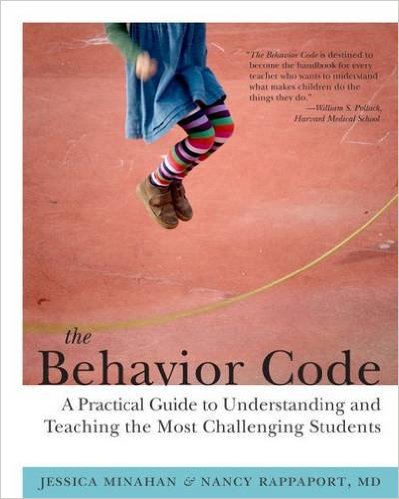
We have written before about self-regulation strategies and teaching children mindfulness; some of these ideas and tools may be effective interventions for helping students cope with anxiety and behavioral difficulties. However, another excellent resource is an informative book written by Dr. Nancy Rappaport and Jessica Minahan titled The Behavior Code: A Practical Guide to Understanding and Teaching the Most Challenging Students. The Behavior Code provides strategies to determine causes and patterns of behavior in order to effectively de-escalate challenging situations. The book is also a treasure trove of worksheets and practical resources.


In their book, the authors emphasize that misbehavior is a symptom of an underlying cause and is a form of communication that serves a function and has a pattern to it. They explain that a displayed maladaptive behavior is often the symptom of underdeveloped skills, such as weak executive functioning, poor self-regulation, or immature social skills. The behavior is often the child’s attempt at solving a problem the best way they know how. Children will continue to engage in the problematic behavior due to the function it serves in getting them a desired result. For example, whining may get the teacher’s attention. Often, when teachers systematically evaluate behavior they will discover a pattern to what triggers or causes the behavior and what function it is serving. Knowing the cause, function, and pattern to challenging behavior is the first step towards helping build effective, personalized, interventions in order to support the child

The authors also provide some tangible tips for working with anxious students:
  • It is common for teachers or caregivers to publicly praise positive behavior. However, children with anxiety don’t always want any extra attention from peers, which can make this strategy ineffective. Private or non-verbal praise is often better for students with anxious tendencies.
  • Students with anxiety often enter into negative thinking cycles. Vague or non-specific praise is easy for them to dismiss. The authors suggest using fact-based praise with specific examples of how the student has done. 
  • There are new biofeedback tools that can turn calming down into a game for students. One such tool is EmWave, which gives students a black and white picture that will slowly fill with color as the device monitors the child’s heart rate and the student begins to calm.