Showing posts with label tips for parents. Show all posts

Friday, January 14, 2022

Using visual routines to help toddlers learn new daily life skills

Former Yellin Center Learning Specialist Renée Jordan is back today with more tips from her work with younger children .


Kids have so many routines to learn in the early years. Whether it is potty training, washing their hands or getting out the door in the morning, there is a stepwise process that they need to learn. However, the CDC, in looking at developmental milestones by the age of two, notes that two or three-step directions are all that most kids that age can hold onto.  But most of these routines require kids to master way more steps than that. Kids simply don’t have the active working memory to navigate these routines yet, which often results in tantrums and resistance.

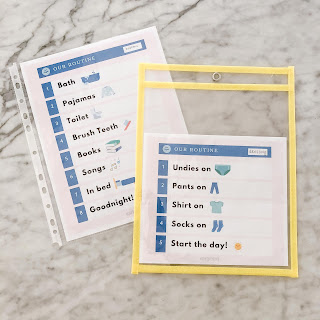
One way to help these pre-reader aged kids learn these routines, and stay on track during the process, is to use a visual routine. Each step is represented by a visual so they don’t need to be able to read the word. As they go through the routine, if they forget the next step they can independently look at the routine and figure out what they need to do next.


The first few times a visual routine is used, you will do it with the child and teach them the steps of the routine. However, after a few uses, they will be able to look at the chart and follow the routine on their own. Over time, they will internalize the routine and no longer need it. They will have learned the steps, and be able to navigate the process independently.

On the Earlybird platform you can find cut & paste versions of helpful visuals that let you personalize routines to your child, or you can print several of their premade routines for bedtime, laundry, morning, hand washing or learning to use the bathroom. Or, you can create your own visuals, perhaps using characters from your child's favorite book or video. 

Friday, December 14, 2018

Toys for Young Children

Any parent who has watched their toddler play with a box, or a wooden spoon and saucepan, can attest to the joy to be found in simple items. This feeling contrasts with the concern many parents feel as they watch their school-aged child stare into a screen as they spend far too long playing a game or passively watching a video . It's no surprise, then, that the American Academy of Pediatrics has recently released a reminder of the importance -- and joys -- of simple play in the development of children.


This Clinical Report, Selecting Appropriate Toys for Young Children in the Digital Era, was designed to guide pediatricians in speaking with parents, but contains important research findings and recommendations that parents will find helpful as well. The authors of the Report include Dr. Alan L. Mendelsohn, FAAP, who, like Dr. Yellin, is a member of the Department of Pediatrics, Division of Developmental-Behavioral Pediatrics, at New York University School of Medicine.

The report notes the importance of imaginative play, problem solving, and physical activity and especially supports the use of "guided play", where children use toys as part of an interaction with their caregiver. This can build social skills and language in a way that solitary play cannot.

Among other topics covered are the need to limit screen time. The Report notes, "there is presently no evidence to suggest that possible benefits of interactive media match those of active, creative, hands-on, and pretend play with more traditional toys."  The Report also discusses the need for toy safety, what to look for in toys for children with disabilities, and the importance of using books for pretend play. Especially in this season of gift giving, this Report is something parents should read, while incorporating its suggestions into their purchases and play with their children.

Wednesday, August 29, 2018

Back to School Tips for Families

The late August heat wave has made it hard to be outdoors, so we've had extra time to catch up on our reading. We've encountered lots of back to school information that we want to share with our readers.

For New York City Families

New York City public schools don't begin classes until after Labor Day and we know that every year there are students who don't have a school assignment as the first day of classes approaches. The folks at InsideSchools.org have a helpful guide with tips on what to do if your middle schooler still needs a place at this late date. They also offer information on how to contact the NYC Department of Education and its various offices for other school related issues that can arise at the beginning of the school year or later in the term.

Navigating the Start of School
Our colleagues at the American Academy of Pediatrics have an excellent set of suggestions on their HealthyChildren.org website for making the first days of school go more smoothly, especially for younger children. They cover topics ranging from travel to and from school -- on foot, by bus, and even by bicycle. They have tips for how to handle bullying and the best ways to develop good sleep and study habits. And they link to more detailed articles on many of these subjects. It's worth reading.

School Supplies
We've always liked the suggestions from Wirecutter, and they have an extensive list of suggestions for back to school items for all ages, including backpacks, writing instruments, organization tools, electronics, and art supplies. They also have recommendations for laptops for college students. 

Dressing for School Success
Scholastic has some practical suggestions for what young children can wear to school that will enable them to be both comfortable and independent. For older students, parents might want to check out whether their child's school has a dress code, and work together with their child to make sure that they can express their personal style in acceptable ways. And both students and parents should keep in mind that the saying "dress for success" has a real basis in scientific research.


Wednesday, June 27, 2018

Record Keeping

Most families have a file, or a box, or a drawer into which they place important documents relating to their children. These can be birth certificates, report cards, even artwork or notes written by their kids. But, as parents of older or adult children can attest, after a while these artifacts add up and there can be the temptation on the part of some parents to toss them all out. Other parents keep everything - for sentimental reasons or out of concern that something will be needed one day. The larger the storage area of one's home and the longer between moves, the more boxes can accumulate. And families of students with disabilities -- medical issues, learning difficulties, or both -- have vastly increased number of medical and educational documents.


There has got to be a better balance. Just what should be kept long-term and what can/should be tossed out after a while?

There is an extensive and detailed list of items to be retained -- and created -- by parents of students receiving special education services, prepared by attorney Robert K. Crabtree, an attorney, on the Wrightslaw website "From Emotions to Advocacy." However, this list is an old one and while still quite helpful, doesn't take into consideration ways to digitize many of these records. Many of the documents you will need to keep, especially IEPs and  educational assessments, can run in the dozens of pages. Scanning and storing these and other records makes a lot of sense. Remember to create back up copies of all of these documents, and to index them in a way that will help you find them, probably by subject: "IEPs", "Test Scores", "Correspondence". Within that index you can list items by date, or author, or both.

Note that some documents are important long after they are created. We know of a number of young adults who needed to document their medical history or inoculations for school or work years after they left their pediatrician's practice.  Having a record of whether one has had chicken pox or when they last had a tetanus shot can be important long after the fact. Keep in mind that your child's physicians and school both will keep records, and physicians have legal obligations to retain records for at least several years after a child reaches adulthood. Still, while you may be able to get a record from the pediatrician or school, it is always easier if you have it at your fingertips.

Most documents, once digitized and carefully backed up, can be shredded. This will leave a few items still in paper format, but the reduced number of paper documents and the careful digital storage and indexing of most files means that when something is needed that it can be retrieved quickly and easily. It can be overwhelming to tackle your child's paper records, but the result can make things easier for years to come.


Photo credit: www.wdstorage.co.uk/via flickr.com


Monday, December 4, 2017

Rejecting Accommodations

The mother of a high school student with attention and reading difficulties recently asked us what she could do to make her son take advantage of the accommodations provided in his IEP. Since her son's learning and attention issues had been diagnosed in fifth grade, he had an IEP that provided for extended time (1.5 times standard time) and a quiet place to take his exams.

As a practical matter, that meant that when his class was taking a test in class, he went to the school library, where he was placed in a small side room. The librarian kept an eye on him while he took his test and he returned to his classroom when he was finished. He went along with this plan until he reached high school, at which time he announced to his parents that he didn't want to be singled out from his friends and that he was embarrassed to have to leave the class for testing. The more his parents pushed back, the more adamant he became. That's when his mom reached out to us.

We had some questions, the answers to which would help determine what might be appropriate to do or say in this not uncommon situation:
  1. Does this student understand why he has been granted extended time and a quiet exam location? Does he understand his learning and attention challenges and how they affect his learning and taking exams? Parents can't expect their students to be comfortable with doing something different than their classmates unless they understand WHY they are doing so.
  2. How was he doing in school? Did the extended time, or failure to utilize the extended time, make a difference in his grades? If so, this could have an impact on his GPA and longer term consequences as he moved on from high school. Did he understand that this could limit his college options? Or, did he find that there really wasn't any substantial difference in how he did? If that was the case, as sometimes happens, he would have to think about the next question.
  3. Was he planning to take the SAT or ACT exams? These two testing companies do not follow the IDEA. They are required to comply with the Americans with Disabilities Act and avoid discriminating against students with disabilities, but they largely determine whether to grant accommodations based upon what a student had been granted and USED during high school. A student who did not use his accommodations might not get them for these high stakes examinations.

These questions helped this family sit down and discuss this issue. His parents shared his most recent testing that supported the need for accommodations, and showed their son how his reading rate improved when the evaluator gave him extra time to complete reading tests. They discussed his plans to attend a competitive  college and looked at the GPA that that particular college required. Eventually, they agreed that the student would forgo his accommodations for two or three months and see how things went. They advised his teachers of this decision, emphasizing that it did not mean that he was declining his extended time. He found that his grades did drop a bit during this period and ultimately he decided that he wanted to continue to use his accommodations. Since the decision was his, it was one that he adhered to. Last we heard, he was using his extended time and quiet location and doing well in school. 

Wednesday, November 22, 2017

How is the School Year Going So Far?

Most years, on the day before Thanksgiving, our blog post contains lists of things we are thankful for, or Thanksgiving books for kids,  or a discussion about gratitude. While we are no less grateful for family, friends, colleagues, and so many other things in our lives, this year we are taking a different approach to Thanksgiving -- using it as a good time to pause and take stock of where your child might be at this point in the school year. 

It is now around three months into the academic year and students have had at least one report card. Review of last year's work has been completed and new content has been taught for a while. So it is a good time to pause and see how things are going so far -- and yet it is early enough in the year to make changes that can make the school year more productive and satisfying for your student. 

For all Students
Thanksgiving weekend is a good time to clear out backpacks. Far too many students will have failed to do this since school started. Ideally, older students should do this on their own, but students with organizational or executive function issues of all ages may need some support with this task. Papers that aren't needed currently should be kept in a "reserve" file, since they may be needed to prepare for year-end tests. Other items can be tossed or, if current, replaced neatly into the backpack - ideally, in clearly marked notebooks or folders. If this task is repeated regularly, perhaps every couple of weeks (or, failing that, at each holiday break throughout the year) some order may prevail. 

Parents may want to find some quiet time this weekend to speak to their student about how things are going in a general way. Is her reading group a good fit? Does she have friends in her class? Does she get along with her teacher? Although many of these kinds of issues come up informally in day to day conversations, having a targeting discussion can be fruitful, and can sometimes reveal issues that parents need to address before more of the school year goes by.

For Students with IEPs or 504 Plans
Hopefully, you had reviewed the IEP or 504 Plan when it was created or revised, likely last Spring. Are your child's teacher(s) following the IEP/504? Is he getting the accommodations and/or services it provides? Sometimes, schools may delay a week or two before they begin related services such as speech or occupational therapy, or academic supports such as resource room. They may need to get staff in place or determine appropriate groupings. But, by now your child should have been getting the supports and services to which he is entitled under his IEP/504 for quite some time. If this isn't the case, you should contact the school (case manager, head of guidance, or principal, depending on who heads up the IEP team). 

If your student is getting what is provided for in the IEP/504, but things are not going well, this is the time to call for a new IEP or 504 meeting. You are entitled to do so at any point, not just annually. But a formal meeting is not required to make minor changes, and you may find that you can effect the changes you want more quickly by meeting informally with the head of the IEP/504 team and putting your agreed-to changes in writing.

For High School Seniors
If you haven't completed your college applications, this holiday weekend might be a good time to do so. Those who are applying early decision or early action will have submitted their applications earlier this month, and most other students are aware that they have until the end of the calendar year, or even later, to finish up their applications. But many places have rolling admissions and once their places are filled, even strong applicants will not be accepted. In addition, students who are applying to specialized college support programs need to keep in mind that these programs are generally small and admit on a first come - first serve basis. While latter applicants might be accepted to the college itself, they can be closed out of the support programs they need to succeed. 

So, Thanksgiving can be more than a time for thanks. It can be a time to take stock of how things are going for your student and to take steps to improve things if there are problems that need to be addressed.

In the meantime, all of us here at The Yellin Center wish you and yours a Happy Thanksgiving!


Wednesday, August 23, 2017

Back to School with an IEP


As summer comes to an end and the new school year begins, there are steps that parents of students with IEPs should be taking to ensure that their children receive the maximum benefit from the services and supports to which they are entitled.


You may have just recently had your annual IEP meeting, or maybe it was held many months ago. In either event, this is the time to review the IEP and make sure you are familiar with the services, supports, and accommodations it provides for your child. Is she due to receive speech and language therapy? Reading support? Extended time on exams? You can't count on your child to accurately report on what goes on during his or her school day. Some children are too young for this task. Others lack the organizational abilities to notice what services they receive or when. And adolescents are often ambivalent about needing and receiving special education services and won't always share with you whether they were getting (and attending) the extra support or accommodations to which they are entitled.

One way to keep abreast of what is going on in school is to set up teacher meetings early in the year and then at some regular interval thereafter. How often this needs to be done depends upon your child's age and school situation. It may be simple to learn what is going on with an elementary child. He or she probably has only one or two teachers, maybe in a co-taught class with both special education and typically learning students. It is more difficult to track the services being provided to a middle school student, one who may have several teachers and half a dozen classes. Even for these students, there may be a single "point person" - perhaps a resource room teacher - who can help you make sure your son or daughter is getting the support to which he or she is entitled.  While high school students may be more aware of what they should be getting and more likely to let you know if there is a problem, they can also "blow off" extra supports. Getting them to advocate for themselves and take responsibility for their own learning, while making sure they get the support they need, can be a delicate balancing act.

Make sure that your child's teachers are aware of the fact that he or she has an IEP and that they have a copy of it and have reviewed it. It happens less often than it used to, but sometimes schools still don't distribute copies of the IEP to each teacher, usually over concerns about student privacy. This misplaced effort to protect students' rights can be a serious problem if teachers don't know what a student needs and is entitled to receive.

One question that parents often ask is how long is too long for services to begin at the start of the new school year. It's rare for services to begin the very first week of school -- but they certainly should be in place by the second or third week of school. Anything later than that is unacceptable and should trigger at call to the head of your child's IEP team. Even if the school offers a reasonable basis for the delay (staff turnover, difficulty hiring new specialists, scheduling issues), the fact remains that your child needs these services and is losing time he or she cannot make up. Keep on top of this issue. And track this issue during the year as well. Turnover or absences may mean your child is not getting services for an extended period, even if things started out fine.

Parents of older students need to make sure their children know is that, more than ever, accommodations on standardized tests like the SAT and ACT depend upon students getting and using accommodations on a regular basis in school. Students who don't use their extended time, for example, may risk not getting extended time on one of these crucial exams, since it may appear that they don't really require this accommodation.

Think about your child's IEP as an obligation of the school to provide your child with "FAPE" - a free, appropriate, public education. Getting the school year off to a good start, with services and accommodations in place and a plan for monitoring these during the year, is the best way to help your child to be successful in his or her new grade.

Monday, July 24, 2017

Helping Young Children Start the School Year

Starting a new school year is a big adjustment for a child at any age, but it can be particularly disorienting for very young children. Preschool- and kindergarten-aged kids are comforted by routines, and so their first time in even the best of classrooms with the most insightful and empathetic of teachers can be a challenge. Here are some ways you can start now, during summer vacation, to ensure your little one’s year gets off to a great start.


  • Start setting your child’s biological clock. Summer sleep schedules with later wake-up times can take a while to undo, and your child may launch her first day at school cranky and sleepy if you don’t plan ahead. At least a week before her first day, get her used to the new schedule by dimming the lights in her play area an hour before her school-year bedtime. Be sure to offer her toys or books instead of electronics in the hour before she goes to bed; the quality of light emitted by screens stimulates the brain and makes it tougher to drift off to sleep later. Get her ready for bed following the same routine you anticipate using during the school year (pajamas, brushing teeth, etc.). Similarly, wake her up at the same time she’ll get up on school days and take her through her anticipated school-day morning routine. Learning these steps in advance means your child has one less new procedure to learn when school begins.
  • Visit the school a few days before the first day. Narrate the trip there in an excited tone of voice so that the route will feel familiar to your child when you report to the school on the first day. If you can, pop into your child’s classroom and explore the playground. This will help your child begin to visualize what school will be like and help her to feel more at ease on the first day.
  • Familiarize your child with his new teacher by referring to her by name instead of saying “your teacher.” If you can find a picture of his teacher on the school website, print it and hang it in a prominent place so she’ll look familiar to your child on the first day. 
  • Role play circle time, lining up for lunch, and show and tell with your child so she’ll know what to expect. Play the part of the teacher and recruit stuffed animals or siblings to act as her classmates. 
  • Model a positive attitude. When you feel anxious or tired, verbalize your feelings and talk through your plan for energizing yourself and realigning your positive thinking. (“Wow, I’m feeling really worried about tomorrow’s big meeting! I guess feeling a little nervous before a big day is normal. I think I’ll listen to some music I like and imagine myself doing really well in the meeting.”) Watching you will help your child realize that these feelings are normal and give him some strategies for coping with them. 
  • Instead of asking if your child is nervous about beginning school, casually ask how your child is feeling about the new year. Resist asking whether your child feels nervous; this suggests that there is something to be nervous about! If your child is behaving normally and doesn’t give you any reason to worry, it’s best to keep worst-case scenario preparations for the initial separation under your hat. Your child will take cues from you about how to feel about the first day.
  • If your child seems anxious or you’ve had difficulty with separation in the past, choose something she can bring to school that reminds her of her family. An article of clothing or piece of inexpensive jewelry is an especially good choice because your child can touch it whenever she needs comfort during the day without having to go to her backpack. Give her a bracelet of yours or let her borrow her brother’s lucky bandana. 

One big no-no: Don’t sneak away on the first day. Although this seems like a good idea for the child who tears up every time you take a step toward the door, resist the urge to wait until his back is turned to disappear. Such behavior can do damage to your child’s trust in you, resulting in the fear that you could vanish at any moment. Instead, assure your child that you love him, that you’re leaving him in a very safe place that you have chosen carefully, and that you will see him in four hours, then bite your lip and leave. Chances are good that you’ll have to pry him away from his new friends by pick-up time.

Wednesday, July 19, 2017

New Research Explores Pitfalls of Homework Help

One question we get a lot here at The Yellin Center is how parents and caregivers can help students grow as learners at home, during homework time, or with supplementary educational activities. We love giving parents and students strategies for building up skills at home, as long as these activities are fun and stress-free, especially during the summer. New research out of Tufts University, conducted by Dr. Melissa Orkin, Sidney May, and Dr. Maryanne Wolf, explores the ways in which parents’ helping behaviors during homework time contribute to how kids feel about their work. 

Homework time, especially for struggling readers and students with disabilities, can be a stressful time for kids and parents alike. Often, homework tasks are not differentiated to meet a student at her or his instructional level; this means that students are often sent home to do work independently that they are not yet able to do. This can lead to task avoidance (a tantrum or power struggle, for example) and negative attitudes towards learning or school. In these situations, parents naturally feel the impetus to sit with their child and help them through the task while building up their skills.


When students are given homework tasks that are too hard to complete independently, they may begin to feel incompetent at managing the academic demands. It would be natural to assume, therefore, that helping your child through the task would increase her or his feelings of competence. However, Orkin and her colleagues found that one common type of homework help, which they dubbed intrusive practices, can actually lead to feelings of helplessness. When students feel helpless in the face of academics, or that they will be unable to produce work at the level expected of them, they will often become very frustrated or have an emotional outburst during work time, seeking to avoid the task.

Intrusive homework help practices include things like checking children’s homework or correcting mistakes when reading. These types of behaviors can contribute to a product (or achievement) oriented learning environment rather than a process-oriented learning environment. Ideally, we want children to value the process of learning, not the output. Sometimes this means taking a step back during homework time and allowing mistakes to be made. Fostering a process-oriented environment also entails providing specific, effort-based praise rather than intrusive corrections during reading or writing that limit the student’s autonomy while working. It’s important for parents and teachers to endorse growth and effort rather than “prescribed standards of success.”

Taking a step back and letting your child make mistakes can be extremely difficult, but research continues to show that encouraging risk-taking while building academic skills is incredibly important for helping children develop a love of learning and a growth mindset. It may take some getting used to, but next time it’s homework time at your house, see what happens when you let mistakes happen while offering up a healthy serving of effort-based encouragement and praise.

Thursday, July 13, 2017

School's Over... No, School's About to Start...

Here in New York City, where most schools run until the end of June and do not begin again until after Labor Day,  the first part of July is a time for students and teachers to catch their breath and to bask in the prospect of weeks of summer break looming ahead. But much marketing by retailers is national in scope, and we've noticed that stores that sell school supplies are busy reaching out to families whose children return to school as early as mid-August. These ads -- for clothing, binders, electronics and the like -- are only going to increase in frequency until things hit a crescendo as summer comes to an end.

So, loathe as we are to interfere with the relaxation that comes with summer, it may be time to consider some products that can make your family's return to school less stressful and more productive. In our work with all kinds of families, we've found that some basic items tend to be the most helpful.

A large white board, mounted in a central location (kitchen wall or door, near the front entry, right by the mud room or garage) can be "command central" for busy families. Need something from the grocery? Write it on the white board. Have a project or permission slip due? Make a note on the whiteboard or actually hang it from the board with a magnetic clip. Some families use a board that is divided into days of the week. Others reserve one area for each family member. And others write on it helter-skelter with lots of colors and underlining. Whatever works for your family...

A large bin or basket for every family member, lined up near the most used exit door. This can hold a backpack, gym clothes, homework folders (which should be in the backpack), and anything else that needs to leave the house with that person. Even mom and dad can find this useful as a place for keys, sunglasses, phones, etc. If you can locate the baskets near a place to plug in a long power strip, everyone can put their phones away (if you can pry them from their hands) and charge them for the upcoming day, all at the same time.
containerstore.com

A supply closet can really help prevent last minute store runs. This can be anywhere you have a couple of extra shelves, which you can stock with packages of notebook paper, folders, glue sticks, boxes of pens and pencils, and printer paper - all bought on sale, of course.  If you have room for a pencil sharpener, manual or electric, all the better. And as the school year progresses, this is a great place to put "leftovers" -- those pieces of poster board you didn't use, the markers left over from a project, or glitter from a craft project. As the year unfolds, these items may come in handy and knowing where to find them is the key to putting them to use. Some families find a similar cabinet in the kitchen for lunch supplies is also helpful - stocked with sandwich fixings that don't need refrigeration, sandwich bread or wraps, juice boxes, packaged healthy snacks, and paper or plastic bags or reusable lunch containers.

A large, easy to read clock in the kitchen can help keep everyone on schedule during the crucial parts of the morning. Too often there are small clocks on various appliances, each off by a minute or two. When catching the school bus or commuter train requires a precise departure time, it can help to have everyone's schedule synchronized.

As you think ahead of other ways to make the transition from summertime to school time easier, don't forget to take plenty of time to read, relax, and enjoy the break from school.


Monday, June 26, 2017

Why Do Kids Lie?

In this age, when terms like "alternate facts" are part of the common parlance and newspapers like The New York Times feature articles like "Trump's Lies", complete with graphics, it may be instructive to look at why people, especially children, learn to tell lies and what motivates them to do so.

The June issue of National Geographic Magazine contains an extensive discussion of why people lie, in a piece entitled "Why We Lie: The Science Behind Our Deceptive Ways". The article looks at the behavior of both adults and children. Adults may lie to cover up bad behavior, or to inflate their own image, or to gain an advantage over others. Colorful tales of con men, politicians, and outright criminals illustrate these motivations.

But why and when do children first learn to lie? The National Geographic piece looks at the work of Professor Kang Lee at the University of Toronto, who has determined that children of two or three don't generally try to conceal their misdeeds, and they don't consistently lie about having done something contrary to the rules (here, peeking at a toy when the adult cautioned them not to do so before he left the room) until about age seven or eight. This "skill" seems to coincide with the acquisition of two specific abilities - the development of what is called "theory of mind", which enables us to consider the perspective of other people, and what are referred to as "executive functions", which are the abilities to plan, pay attention, and control our behaviors. As these two skills first emerge in children (and executive functions notably continue to develop well into early adulthood) children become more skilled at lying.


Not all lying is malicious. Reasons for lying include helping other people or avoiding rudeness. But parents may understandably be concerned about children who lie repeatedly, or who lie about things that can be harmful to themselves or others. We've written before about what parents can do when their children lie, and it may be a good time to take another look at these suggestions.

Wednesday, June 14, 2017

Attorneys at IEP Meetings

Parents sometimes ask whether it would be helpful if they brought an attorney to their IEP meeting. The U.S. Department of Education (DOE) addressed this question last year in an advisory letter to the Illinois State Board of Education, which had sought guidance on the respective rights of school districts and families.


The DOE noted that parents have the right to bring anyone who has knowledge or special expertise regarding their child to the IEP meeting and that it is the judgment of the parents whether any particular individual falls within that definition. The DOE further noted that while the school district must give parents advance notice as to who will be attending the IEP meeting, parents do not have to advise the district in advance if they are bringing someone with them, including an attorney.

If a parent does bring an attorney to the IEP meeting, the district may seek to adjourn the meeting, but only if the parent agrees and the delay would not delay or deny the child from receiving an appropriate education.

The DOE notes, that "... in the spirit of cooperation and working together as partners in the child’s education, a parent should provide advance notice to the [district] if he or she intends to bring an attorney to the IEP meeting. However, there is nothing in the IDEA or its implementing regulations that would permit the [district] to conduct the IEP meeting on the condition that the parent’s attorney not participate, and to do so would interfere with the parent’s rights..."

They go on to state: "Finally, we would like to note that, even if an attorney possessed knowledge or special expertise regarding the child, an attorney’s presence could have the potential for creating an adversarial atmosphere that would not necessarily be in the best interest of the child. Therefore, [it is our] longstanding position is that the attendance of attorneys at IEP meetings should be strongly discouraged."

While there may be substantive reasons not to bring an attorney to the IEP meeting, we always suggest that parents try not to attend meetings on their own and that they should bring someone with them for support and to take notes. That can be the child's other parent, a friend, or an advocate. For other tips, take a look at our posts on this topic.

Monday, February 13, 2017

Sugar Cravings in Kids

Valentine’s Day is tomorrow and, like Halloween, that may mean a tidal wave of heart-shaped candies is about to take over your child’s diet. In preparation for this celebration of sweets and sweethearts, we have some tips for helping your children (and yourself!) learn to curb those sugar cravings. These recommendations come from the American Academy of Pediatrics and the Intuitive Eating program, set out in a book by two forward-thinking nutritionists.

Even though we’re all born with a love of sweet foods, a full-fledged sweet tooth and the cravings that come with it are more a product of our environment. Eating a diet high in sugar leads us to crave more foods with even more sugar. The first step to reducing our “need” for sugar, therefore, is figuring out all the places that extra sugar is getting into our and our children’s food. There are the obvious culprits, of course – candy, baked goods, sugary cereals – but it can be quite surprising, and unsettling, to realize just how prevalent sugar is when it comes to foods we may think of as healthy. Much of the packaged and processed food sold at grocery stores is loaded with sugar. Some particularly naughty culprits are granola, yogurt, beverages, jams or jellies, canned fruit, and tomato sauce. Foods marketed as “low fat” also often have extra sugar to replace the taste you lose when you remove the fat. Figuring out the biggest contributors can help you and your family develop a battle plan to start cutting back.

Barring a child from enjoying a treat every now and then, especially on a holiday that more or less is focused on sharing sweet treats with friends, is an unrealistic endeavor. However, there is plenty of room for cutting back. Two of the most common “uses” of candy are rewards and bribes. It’s tempting to use some chocolate to get your child to finish her homework, or take them out for a sundae after earning a high mark. However, associating sugar with the feeling of relief (finishing homework) and pride (getting good grades) has the potential to devalue both the sugary treat and the activity or endeavor. Instead of turning to sweets, consider some potential alternatives. For example, lots of children crave nothing more than honest, effort-focused praise after they’ve done something really noteworthy, just so they know you are really proud. The American Academy of Pediatrics also warns against the growing “tolerance” to candy as bribes and rewards; eventually, children are going to expect bigger and bigger incentives, potentially negating their natural motivation to succeed and feel good about their work.

Another area to reconsider is the use of sweets as a marker of celebrations. Birthdays, sports games, holidays, and family milestones are often defined by a cake or other sugary sweet. Some schools have begun trading in the birthday cupcakes for healthier options, or celebrating in a different way altogether. When your blogger was in elementary school, a school birthday was focused exclusively on the treat, even though there are plenty of other ways to spend those twenty minutes. Maybe the class can snack on some strawberries while the birthday child leads a game of freeze dance. Birthday parties and sports games also seem to be dominated by brightly frosted cupcakes and candy bars, but it’s likely that fruit and popcorn will go over just as well if the kids are really engaged in having a good time with the activities.

Finally, consider changing the culture around “junk food” in your house. Rather than making chocolate and cookies the forbidden food under tight lock and key, make them available just like all the healthy food you’re already offering around the clock. This may seem counter-intuitive at first, but we all know that we crave what we can’t have. Helping kids learn how to balance their nutritional needs and make choices that will make them feel good on the inside is a surefire way to set them up for good eating habits. That doesn’t mean your nine-year-old isn’t going to eat one too many cookies every now and again, but habits are developed throughout our childhoods, and kids will naturally choose foods that their bodies need if all the options are on the table.

If you are considering recalibrating the way your household consumes sweets and treats, don’t forget to be open and honest with every member of the family about it. Even young children can understand the value of nutrition, and we know that they’re much more likely to be on board if they have a voice in the matter.

For more information about some healthier snack options for growing bodies, the American Academy of Pediatrics has published a short guide that may be helpful.